
MOTS-c
Also known as Mitochondrial ORF of the 12S rRNA type-c · Mitochondrial-derived peptide MOTS-c · MOTSc · MOTS-C
In cell-culture systems, MOTS-c acts as a regulatory microprotein that modulates the cytosolic folate–methionine one-carbon cycle.
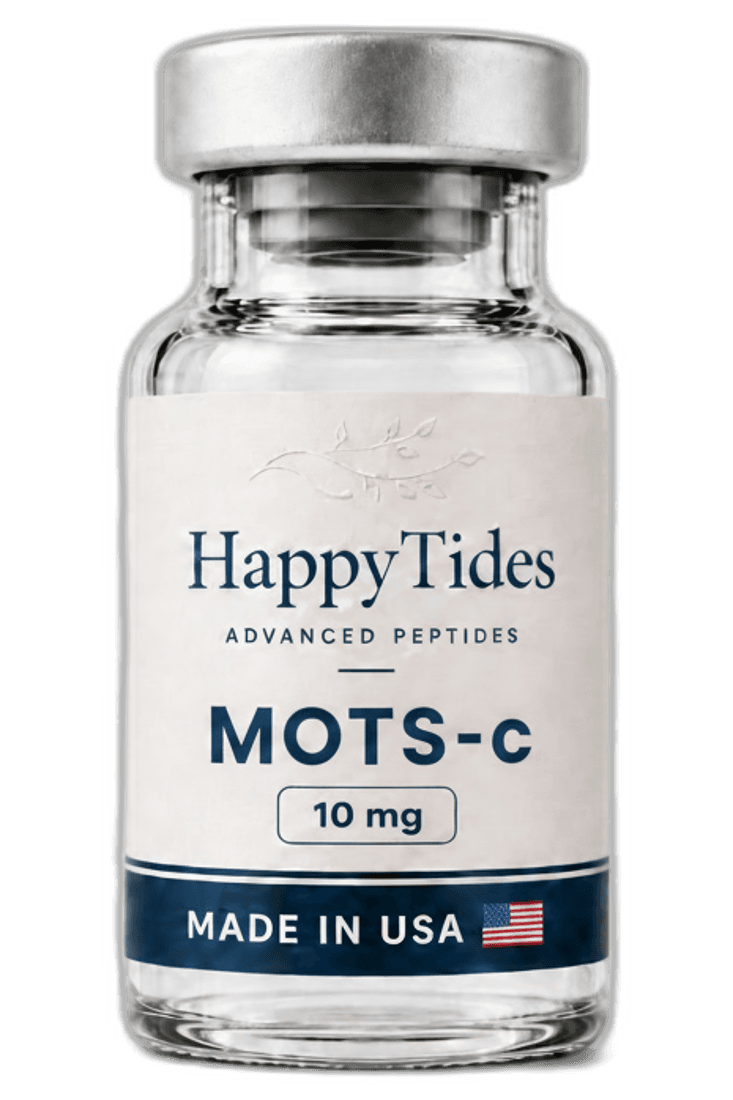
The overview
What is MOTS-c?
In cell-culture systems, MOTS-c acts as a regulatory microprotein that modulates the cytosolic folate–methionine one-carbon cycle. By attenuating de novo purine biosynthesis, it promotes accumulation of the intermediate AICAR (5-aminoimidazole-4-carboxamide ribonucleotide), an allosteric activator of AMP-activated protein kinase (AMPK). This represents a non-canonical route to AMPK signaling that is largely independent of acute changes in the cellular AMP:ATP ratio. Under metabolic-stress conditions (e.g., glucose restriction or oxidative challenge) in vitro, MOTS-c translocates from the cytosol to the nucleus in an AMPK-dependent manner, where it associates with stress-responsive transcription factors including NFE2L2/NRF2 and occupies antioxidant-response-element (ARE) and other regulatory regions, shaping nuclear gene-expression programs related to metabolism and redox balance. Reported receptor/signaling readouts in model systems include AMPK phosphorylation, modulation of insulin-stimulated glucose uptake pathways, and altered mitonuclear transcriptional crosstalk. These are mechanistic, model-system observations of signaling behavior and are not statements of clinical efficacy.
In the research
Where MOTS-c shows up
The areas researchers focus on with MOTS-c - and why it has the science community paying attention.
- AMPK signaling activation in cultured cells and rodent tissue models
- Mitonuclear retrograde communication and stress-induced nuclear translocation
- Folate/one-carbon metabolism and de novo purine biosynthesis modulation (AICAR accumulation)
- NRF2/ARE-mediated antioxidant transcriptional response in vitro
- Mitochondrial-derived peptide (MDP) biology and microprotein discovery
- Skeletal-muscle metabolic gene-expression and exercise-responsive signaling in animal models
By the numbers
The facts that matter
To the molecule
Molecular specifications
MRWQEMGYIFYPRKLR (Met-Arg-Trp-Gln-Glu-Met-Gly-Tyr-Ile-Phe-Tyr-Pro-Arg-Lys-Leu-Arg)Sourced, not claimed
The science behind it
The peer-reviewed studies behind MOTS-c, linked so you can read them yourself.
- Lee, C., et al. (2015). The mitochondrial-derived peptide MOTS-c promotes metabolic homeostasis and prevents obesity and insulin resistance. Cell Metabolism.
- Reynolds, J. C., et al. (2021). MOTS-c promotes physical performance and prevents age-associated metabolic decline. Nature Communications.
Straight answers
Questions, answered
Is MOTS-c approved by the FDA?
No. MOTS-c is not an FDA-approved drug. We supply it as a research-use-only reference compound, identity-verified for purity with a COA on every vial.
What class of compound is MOTS-c?
MOTS-c is classified as: Mitochondrial-derived peptide (MDP); 16-residue bioactive microprotein encoded by a short open reading frame within the mitochondrial 12S rRNA (MT-RNR1) gene.
What is the molecular weight of MOTS-c?
The molecular weight of MOTS-c is 2174.62 g/mol (monomer free peptide), with a molecular formula of C101H152N28O22S2.
What is the CAS number for MOTS-c?
The CAS Registry Number for MOTS-c is 1627580-64-6.
What is the amino acid sequence of MOTS-c?
MOTS-c has the sequence: MRWQEMGYIFYPRKLR (Met-Arg-Trp-Gln-Glu-Met-Gly-Tyr-Ile-Phe-Tyr-Pro-Arg-Lys-Leu-Arg).
Available now
Get MOTS-c
Identity-verified, third-party tested, made in the USA, and traceable to its lot - with a scannable COA on every vial. For research use only.
See pricing & order →Go deeper
More on MOTS-c
Keep exploring
Related peptides
For in-vitro laboratory research use only. Not for human or animal consumption. Bodily introduction into humans or animals is strictly prohibited by law. MOTS-c is not a drug and is not intended to diagnose, treat, cure, or prevent any disease. These statements have not been evaluated by the FDA.
Complete the stack
Researchers often pair MOTS-c with

The headline mitochondrial-longevity pair - MOTS-c (AMPK signaling) is explicitly co-modeled with NAD+ substrate research.
Mitochondrial-metabolic research crossed with GH-axis research in performance literature.
Mitochondrial-energy research documented alongside GH-axis metabolic research.