
MOTS-c Reconstitution Guide
Part of the full MOTS-c guide - a mitochondrial-derived peptide reference compound, identity-verified with a COA on every vial.
In brief
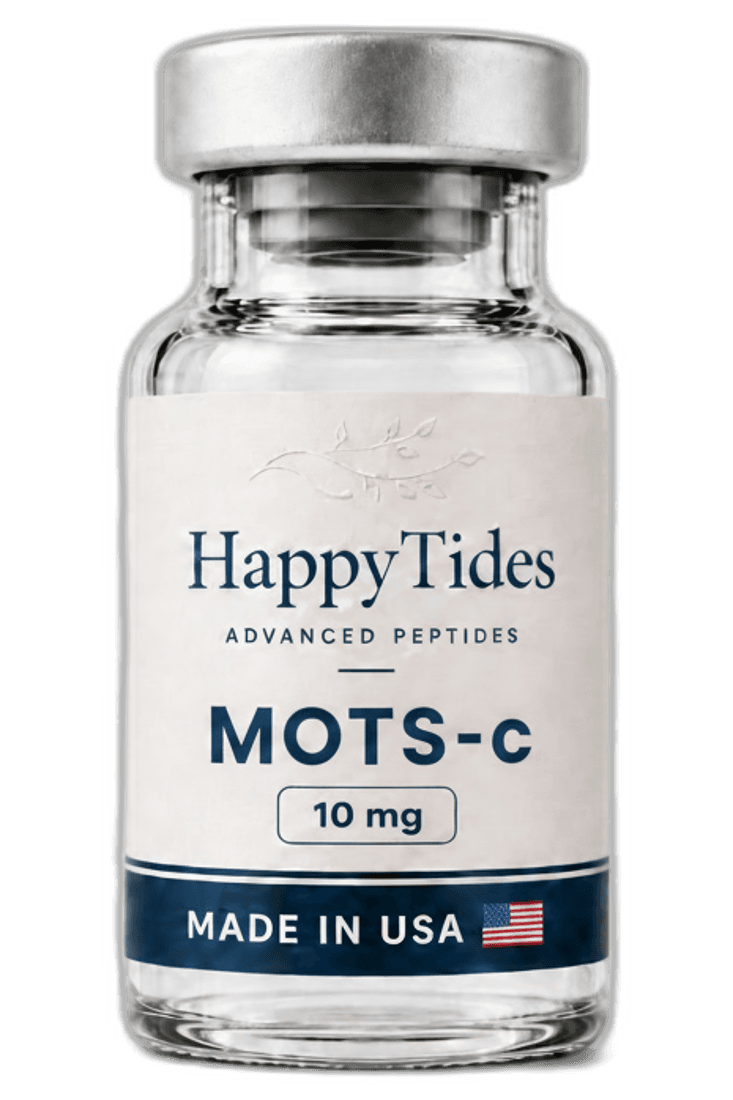
This section describes laboratory reconstitution of lyophilized MOTS-c for in-vitro research handling only. It is not a human dosing protocol and contains no personal-use guidance. Like other research peptides supplied as a freeze-dried solid, MOTS-c is reconstituted by dissolving the lyophilized powder in a suitable diluent so that a known mass occupies a known volume, yielding a defined working concentration for bench use. The relevant molecular anchor is the stated monomer free-peptide molecular weight of 2174.62 g/mol, which underpins any molar-concentration calculation. Bacteriostatic water (sterile water containing a low percentage of benzyl alcohol) is the conventional diluent for multi-draw research vials because the preservative limits microbial growth across repeated aliquoting. The principle below is general peptide-handling practice expressed in laboratory terms; where MOTS-c-specific stability data are not provided in the entry, conservative cold-chain handling is assumed rather than precise figures invented.
The detail
A closer look
01
Concentration math from the stated molecular weight
Reconstitution concentration is set by choosing how much diluent to add to a known peptide mass. The mass-per-volume concentration is simply peptide mass divided by diluent volume; for example, dissolving a vial in 2 mL of bacteriostatic water gives a concentration of (vial mass in mg) / 2 mL in mg/mL. To express this in molar terms for in-vitro work, divide the mg/mL figure by the molecular weight of 2174.62 g/mol (equivalently 2174.62 mg/mmol). Smaller diluent volumes yield more concentrated stocks; larger volumes yield more dilute, easier-to-aliquot stocks. The molecular weight provided in the entry is the only constant required for these calculations, so no assumed or invented potency values are needed to convert between mass and molar concentration at the bench.
02
Stability and storage handling in the laboratory
As a lyophilized peptide, MOTS-c is generally most stable in its dry, freeze-dried state and should be kept cold and sealed until reconstitution to limit moisture uptake. Once dissolved, peptide solutions are typically treated as more labile than the dry powder, so reconstituted research stock is conventionally refrigerated for short-term bench use and frozen in single-use aliquots for longer-term storage to avoid repeated freeze-thaw cycles. Because the entry does not provide MOTS-c-specific shelf-life or degradation figures, these are general peptide-class handling conventions stated as such, not peptide-specific guarantees. Minimizing light exposure, avoiding repeated warming, and reconstituting only what a given experiment requires are standard practices that preserve sample integrity for accurate in-vitro measurements.
Step by step
How MOTS-c is reconstituted
A bench reference for handling and preparation in an in-vitro research setting. Not a personal dosing protocol.
- 1
Equilibrate the sealed lyophilized MOTS-c vial and the bacteriostatic water to room temperature before opening, to reduce condensation onto the dry powder.
- 2
Sanitize the vial stoppers with an alcohol wipe and work in a clean, contamination-controlled area.
- 3
Choose a target diluent volume based on the working concentration needed; record the volume so the mg/mL concentration can be calculated against the known vial mass.
- 4
Draw the chosen volume of bacteriostatic water and add it slowly down the inner vial wall rather than directly onto the powder, to minimize foaming and shear on the peptide.
- 5
Do not shake; gently swirl or roll the vial and allow the solid to dissolve fully into a clear solution.
- 6
Calculate the resulting concentration: mg/mL = vial mass (mg) / diluent volume (mL); convert to molar by dividing mg/mL by 2174.62 g/mol if molar units are required.
- 7
Label the vial with concentration, diluent, and date, then store cold; aliquot into single-use fractions to avoid repeated freeze-thaw for longer-term storage.
- 8
Use the reconstituted stock only for in-vitro / laboratory research handling; this preparation is not a human dosing protocol.
The fine print: products are sold for laboratory research use only and are not for human or animal consumption. Bodily introduction into humans or animals is strictly prohibited by law. MOTS-c is not a drug and is not intended to diagnose, treat, cure, or prevent any disease. These statements have not been evaluated by the FDA.