
MOTS-c Mechanism of Action
Part of the full MOTS-c guide - a mitochondrial-derived peptide reference compound, identity-verified with a COA on every vial.
In brief
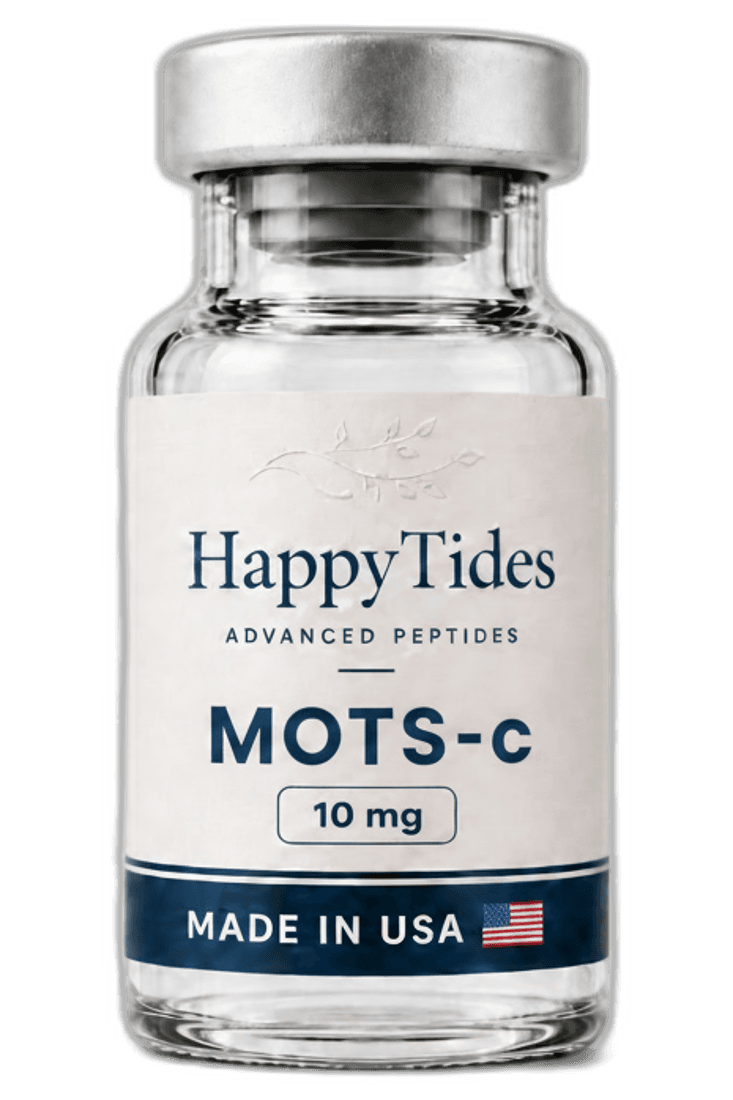
MOTS-c is a 16-residue mitochondrial-derived peptide (MDP) translated from a short open reading frame embedded in the mitochondrial 12S rRNA (MT-RNR1) gene, and its signaling behavior in cell-culture systems is unusual among peptides because it works through intermediary metabolism rather than a classical surface receptor. In model systems it operates as a regulatory microprotein that re-routes the cytosolic folate-methionine one-carbon cycle. Rather than docking a transmembrane receptor to trigger a second-messenger cascade, it perturbs a biosynthetic flux, and that perturbation is read out downstream as a kinase-activation event. The sections below unpack how that flux change converts into AMP-activated protein kinase (AMPK) signaling, how the peptide moves between cellular compartments under stress in vitro, and how it associates with transcription factors at defined DNA regulatory elements. Every readout described here is a mechanistic, model-system observation of signaling behavior, not a statement of clinical effect.
The detail
A closer look
01
From the one-carbon cycle to AICAR-driven AMPK activation
In cultured cells, MOTS-c modulates the cytosolic folate-methionine one-carbon cycle and attenuates de novo purine biosynthesis. Because AICAR (5-aminoimidazole-4-carboxamide ribonucleotide) is an intermediate in that purine pathway, slowing flux downstream of AICAR causes the intermediate to accumulate. AICAR is a well-characterized allosteric activator of AMPK, so its build-up provides a direct biochemical bridge from a metabolic-flux change to kinase activation. The reported readout is increased AMPK phosphorylation. What makes this route non-canonical is that it does not depend on an acute shift in the cellular AMP:ATP ratio, the classical trigger for AMPK. MOTS-c therefore represents an energy-charge-independent entry point into AMPK signaling in these model systems, a mechanism documented by Lee et al. 2015 (PMID 25738459).
02
Stress-induced nuclear translocation and NRF2/ARE association
Under metabolic-stress conditions in vitro, such as glucose restriction or oxidative challenge, MOTS-c does not remain confined to the cytosol. Model-system data show it translocates from the cytosol into the nucleus, and this relocation is AMPK-dependent, linking the kinase activation described above to a change in the peptide's subcellular distribution. Once nuclear, MOTS-c associates with stress-responsive transcription factors, notably NFE2L2/NRF2, and occupies antioxidant-response-element (ARE) regions and other regulatory sites. This positions it to shape nuclear gene-expression programs tied to metabolism and redox balance, an example of mitonuclear retrograde communication where a mitochondrially encoded peptide feeds back onto the nuclear genome. Kim et al. 2018 (PMID 29983246) characterized this translocation and NRF2 interaction in model systems.
03
Mitonuclear crosstalk and downstream signaling readouts
The combined picture from these model systems is a two-stage signaling logic: a cytosolic, flux-based activation of AMPK, followed by an AMPK-gated movement of the peptide into the nucleus where it participates in transcriptional regulation. Reported receptor and signaling readouts include AMPK phosphorylation, modulation of insulin-stimulated glucose-uptake pathways, and altered mitonuclear transcriptional crosstalk. Because MOTS-c is encoded within mtDNA yet acts on nuclear targets, it functions as a retrograde signal carrying information about mitochondrial and metabolic state outward to the nuclear gene-expression machinery. These observations describe how the peptide behaves as a signaling molecule in defined laboratory contexts. They are mechanistic findings in cultured cells and tissue models and are not statements of clinical efficacy or therapeutic outcome.
The fine print: products are sold for laboratory research use only and are not for human or animal consumption. Bodily introduction into humans or animals is strictly prohibited by law. MOTS-c is not a drug and is not intended to diagnose, treat, cure, or prevent any disease. These statements have not been evaluated by the FDA.