
MOTS-c - Frequently Asked Questions
Part of the full MOTS-c guide - a mitochondrial-derived peptide reference compound, identity-verified with a COA on every vial.
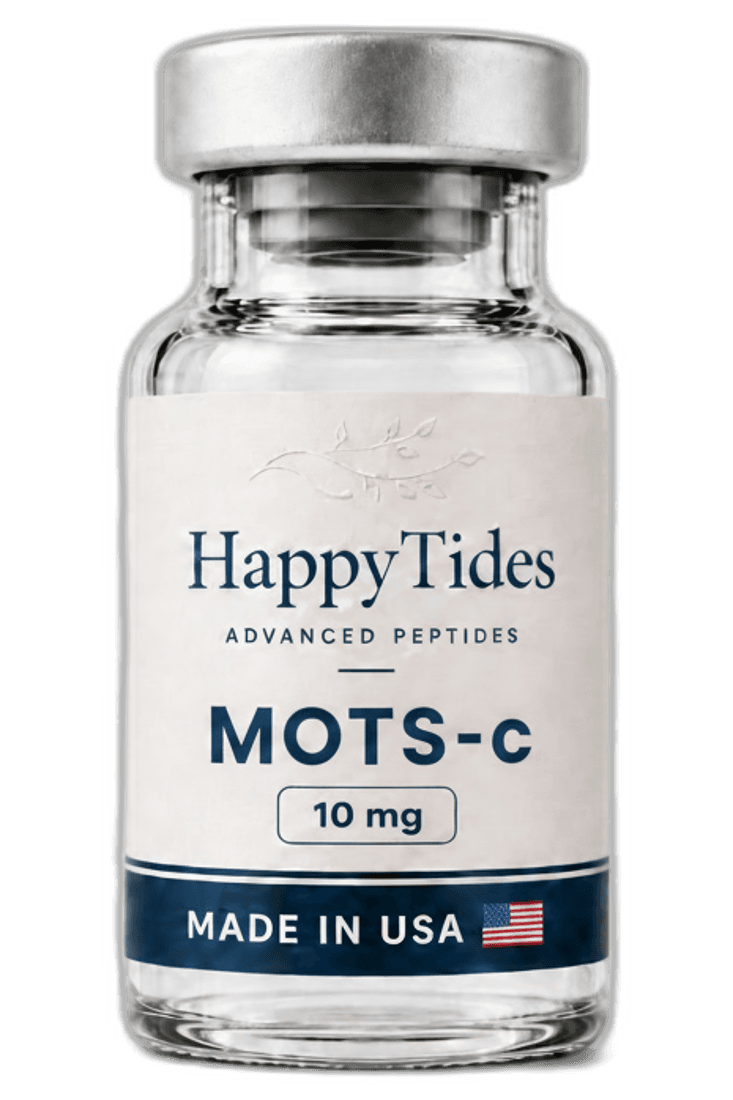
Straight answers
MOTS-c, answered
What class of molecule is MOTS-c?
MOTS-c is a mitochondrial-derived peptide (MDP), a 16-residue bioactive microprotein encoded by a short open reading frame within the mitochondrial 12S rRNA (MT-RNR1) gene. It belongs to the family of microproteins encoded inside mitochondrial DNA.
What is the amino acid sequence of MOTS-c?
The 16-residue sequence is MRWQEMGYIFYPRKLR (Met-Arg-Trp-Gln-Glu-Met-Gly-Tyr-Ile-Phe-Tyr-Pro-Arg-Lys-Leu-Arg). It is a single linear chain with two methionine residues and no cysteines, so it has no disulfide bonds.
What are the molecular weight and formula?
The monomer free-peptide molecular weight is 2174.62 g/mol and the molecular formula is C101H152N28O22S2. The two sulfur atoms correspond to the two methionine residues in the sequence.
What is the CAS number and PubChem identifier for MOTS-c?
The CAS Registry Number is 1627580-64-6 and the PubChem CID is 146675088. These identifiers fix the exact molecular entity for cross-referencing across chemical registries.
What is the primary signaling mechanism studied in model systems?
In cell-culture systems MOTS-c modulates the cytosolic folate-methionine one-carbon cycle, attenuating de novo purine biosynthesis so that the intermediate AICAR accumulates and allosterically activates AMPK. This is a non-canonical route to AMPK signaling that is largely independent of the cellular AMP:ATP ratio (Lee et al. 2015, PMID 25738459).
Does MOTS-c interact with the nucleus?
Yes, in model systems. Under metabolic stress in vitro, such as glucose restriction or oxidative challenge, MOTS-c translocates from the cytosol to the nucleus in an AMPK-dependent manner and associates with NRF2 at antioxidant-response elements (ARE), shaping stress-responsive gene-expression programs (Kim et al. 2018, PMID 29983246).
When and by whom was MOTS-c discovered?
MOTS-c was identified in 2015 by Changhan Lee in the Pinchas Cohen laboratory at the USC Leonard Davis School of Gerontology, reported in Lee et al. 2015, Cell Metabolism (PMID 25738459).
What research areas do the cited sources cover?
The cited literature covers AMPK signaling activation, mitonuclear retrograde communication and stress-induced nuclear translocation, folate/one-carbon metabolism and AICAR accumulation, NRF2/ARE antioxidant transcriptional response, broader mitochondrial-derived peptide biology, and exercise-responsive skeletal-muscle signaling in animal models.
Is the MOTS-c sequence conserved across species?
Yes. The entry notes MOTS-c is highly conserved across roughly fourteen mammalian species including human and mouse, with the first approximately eleven residues being especially conserved, which suggests functional importance of the N-terminal region.
How is MOTS-c reconstituted for laboratory research?
For in-vitro handling, lyophilized MOTS-c is dissolved in a diluent such as bacteriostatic water to a defined concentration. Mass-per-volume concentration equals vial mass divided by diluent volume, and molar concentration is obtained by dividing the mg/mL figure by the molecular weight of 2174.62 g/mol. This is laboratory preparation only, not a human dosing protocol.
What is the regulatory and usage status of this material?
This material is described strictly for research use only (RUO). All information here pertains to in-vitro, receptor-signaling, and laboratory-research contexts. The mechanistic findings are model-system observations and are not statements of clinical efficacy, and nothing here constitutes guidance for human use.
The fine print: products are sold for laboratory research use only and are not for human or animal consumption. Bodily introduction into humans or animals is strictly prohibited by law. MOTS-c is not a drug and is not intended to diagnose, treat, cure, or prevent any disease. These statements have not been evaluated by the FDA.