
Tesamorelin
Also known as TH9507 · TH-9507 · trans-3-hexenoyl-GHRH(1-44) · tesamorelin acetate
In receptor-level and cell-based systems, tesamorelin is a stabilized analog of growth hormone-releasing hormone that binds the GHRH receptor (GHRHR), a class B G-protein-coupled receptor expressed on anterior pituitary somatotroph cells.
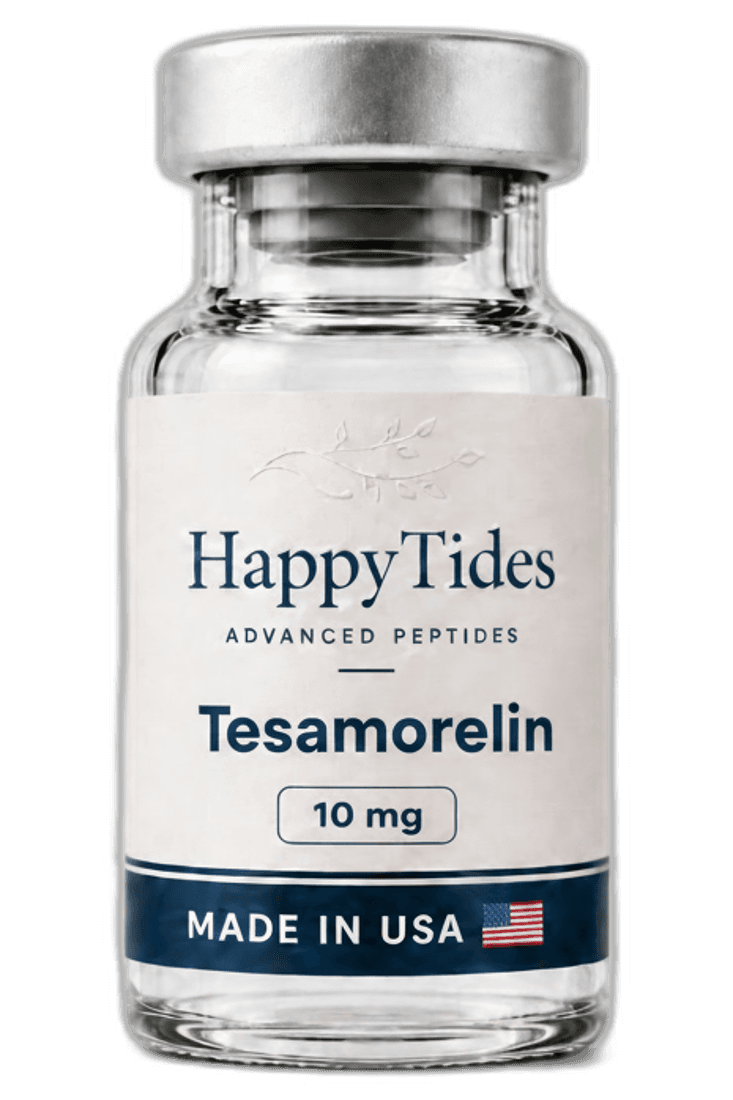
The overview
What is Tesamorelin?
In receptor-level and cell-based systems, tesamorelin is a stabilized analog of growth hormone-releasing hormone that binds the GHRH receptor (GHRHR), a class B G-protein-coupled receptor expressed on anterior pituitary somatotroph cells. Receptor engagement couples to the stimulatory G-protein (Gs), activating adenylyl cyclase and raising intracellular cAMP, which activates protein kinase A (PKA). PKA-mediated phosphorylation of transcription factors such as CREB modulates growth-hormone gene transcription and somatotroph secretory-vesicle mobilization, the canonical GHRH signaling cascade. Structurally, tesamorelin retains the full native GHRH(1-44) sequence but carries a trans-3-hexenoyl group on the N-terminal tyrosine; this lipophilic modification confers resistance to dipeptidyl peptidase-4 (DPP-4) cleavage, the principal route of native GHRH inactivation, prolonging the molecule's stability while preserving receptor-binding determinants. Reported in-vitro and pharmacologic characterizations describe GHRHR agonism and downstream cAMP/PKA pathway activation as the defining signaling properties of the molecule.
In the research
Where Tesamorelin shows up
The areas researchers focus on with Tesamorelin - and why it has the science community paying attention.
- GHRH receptor (GHRHR) class B GPCR binding and agonist pharmacology
- Gs/adenylyl cyclase/cAMP/PKA signal-transduction studies in somatotroph cell models
- CREB phosphorylation and growth-hormone gene transcription regulation
- DPP-4 enzymatic-stability and peptide-degradation kinetics of N-acylated GHRH analogs
- Structure-activity relationships of N-terminal lipidation on GHRH-family peptides
- Population/preclinical pharmacokinetic modeling of long-acting GHRH analogs
By the numbers
The facts that matter
To the molecule
Molecular specifications
Tyr-Ala-Asp-Ala-Ile-Phe-Thr-Asn-Ser-Tyr-Arg-Lys-Val-Leu-Gly-Gln-Leu-Ser-Ala-Arg-Lys-Leu-Leu-Gln-Asp-Ile-Met-Ser-Arg-Gln-Gln-Gly-Glu-Ser-Asn-Gln-Glu-Arg-Gly-Ala-Arg-Ala-Arg-Leu-NH2 (one-letter: YADAIFTNSYRKVLGQLSARKLLQDIMSRQQGESNQERGARARL); native human GHRH(1-44) sequence bearing a trans-3-hexenoyl (3-hexenoic acid) group on the alpha-amino group of the N-terminal Tyr1, with C-terminal amidationSourced, not claimed
The science behind it
The peer-reviewed studies behind Tesamorelin, linked so you can read them yourself.
- Falutz, J., et al. (2010). Effects of tesamorelin on visceral adipose tissue and metabolic parameters. New England Journal of Medicine.
- Stanley, T. L., et al. (2014). Effect of tesamorelin on visceral fat and liver fat: a randomized clinical trial. JAMA.
Straight answers
Questions, answered
Is Tesamorelin approved by the FDA?
No. Tesamorelin is not an FDA-approved drug. We supply it as a research-use-only reference compound, identity-verified for purity with a COA on every vial.
What class of compound is Tesamorelin?
Tesamorelin is classified as: Synthetic growth hormone-releasing hormone (GHRH/GRF) analog; N-terminally lipid-modified 44-residue peptide; GHRH receptor (GHRHR) agonist.
What is the molecular weight of Tesamorelin?
The molecular weight of Tesamorelin is 5135.9 g/mol (average; ~5136 Da per PubChem CID 16137828), with a molecular formula of C221H366N72O67S.
What is the CAS number for Tesamorelin?
The CAS Registry Number for Tesamorelin is 218949-48-5.
What is the amino acid sequence of Tesamorelin?
Tesamorelin has the sequence: Tyr-Ala-Asp-Ala-Ile-Phe-Thr-Asn-Ser-Tyr-Arg-Lys-Val-Leu-Gly-Gln-Leu-Ser-Ala-Arg-Lys-Leu-Leu-Gln-Asp-Ile-Met-Ser-Arg-Gln-Gln-Gly-Glu-Ser-Asn-Gln-Glu-Arg-Gly-Ala-Arg-Ala-Arg-Leu-NH2 (one-letter: YADAIFTNSYRKVLGQLSARKLLQDIMSRQQGESNQERGARARL); native human GHRH(1-44) sequence bearing a trans-3-hexenoyl (3-hexenoic acid) group on the alpha-amino group of the N-terminal Tyr1, with C-terminal amidation.
Available now
Get Tesamorelin
Identity-verified, third-party tested, made in the USA, and traceable to its lot - with a scannable COA on every vial. For research use only.
See pricing & order →Go deeper
More on Tesamorelin
Keep exploring
Related peptides
For in-vitro laboratory research use only. Not for human or animal consumption. Bodily introduction into humans or animals is strictly prohibited by law. Tesamorelin is not a drug and is not intended to diagnose, treat, cure, or prevent any disease. These statements have not been evaluated by the FDA.
Complete the stack
Researchers often pair Tesamorelin with
Both GHRH-analog mechanism - the GH-axis sibling pairing, frequently co-referenced.
GH-axis research overlaps mitochondrial-metabolic research in body-composition literature.
