
Tesamorelin Specs: Sequence, MW & CAS
Part of the full Tesamorelin guide - a synthetic growth hormone-releasing hormone reference compound, identity-verified with a COA on every vial.
In brief
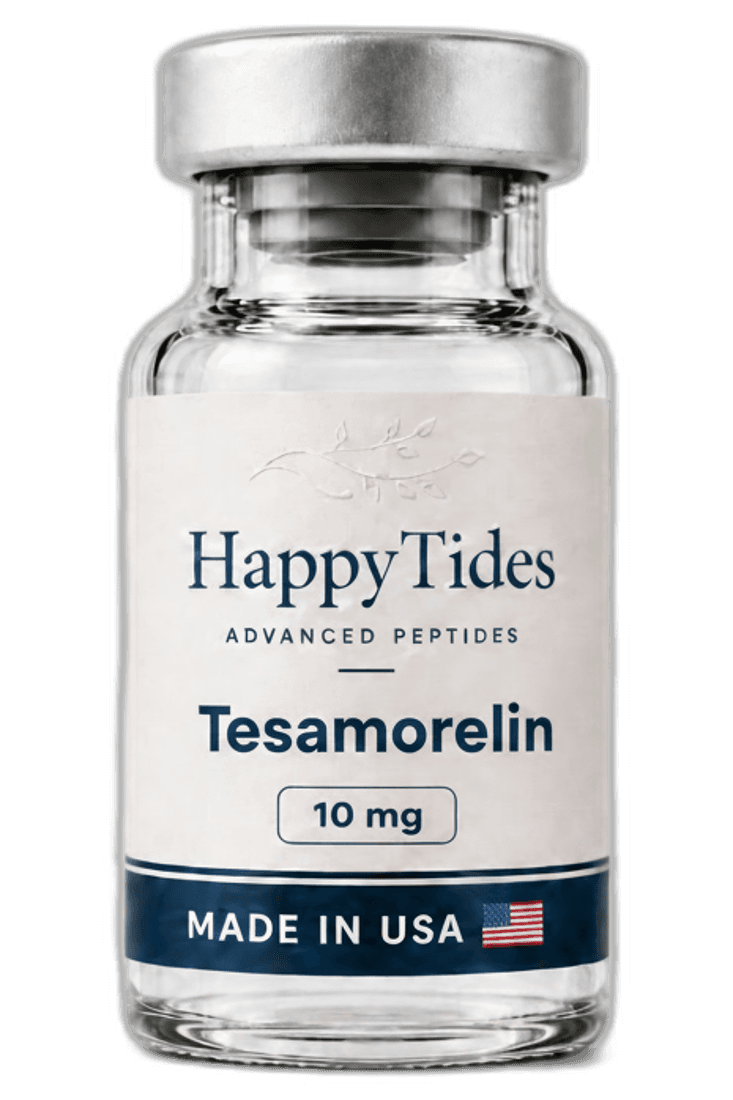
Tesamorelin's molecular specification reads as a precise structural fingerprint. It is a synthetic GHRH/GRF analog, an N-terminally lipid-modified 44-residue peptide and GHRHR agonist, with the average molecular weight of 5135.9 g/mol (approximately 5136 Da), molecular formula C221H366N72O67S, and CAS Registry Number 218949-48-5 for the free base. Its PubChem Compound Identifier is 16137828, and its original development code was TH9507 (TH-9507). The full sequence is the native human GHRH(1-44) chain, one-letter YADAIFTNSYRKVLGQLSARKLLQDIMSRQQGESNQERGARARL, bearing a trans-3-hexenoyl group on the alpha-amino group of N-terminal Tyr1 and a C-terminal amide. Each of these identifiers carries structure-function meaning: the formula and mass quantify the molecule, the sequence defines its receptor-binding identity, and the single N-terminal acyl group plus the amide cap are the deliberate departures from native GHRH. The sections below unpack what these specifications mean for identity, structure, and function as recorded in the entry.
To the molecule
Molecular specifications
Tyr-Ala-Asp-Ala-Ile-Phe-Thr-Asn-Ser-Tyr-Arg-Lys-Val-Leu-Gly-Gln-Leu-Ser-Ala-Arg-Lys-Leu-Leu-Gln-Asp-Ile-Met-Ser-Arg-Gln-Gln-Gly-Glu-Ser-Asn-Gln-Glu-Arg-Gly-Ala-Arg-Ala-Arg-Leu-NH2 (one-letter: YADAIFTNSYRKVLGQLSARKLLQDIMSRQQGESNQERGARARL); native human GHRH(1-44) sequence bearing a trans-3-hexenoyl (3-hexenoic acid) group on the alpha-amino group of the N-terminal Tyr1, with C-terminal amidationThe detail
A closer look
01
Formula, mass, and registry identifiers
The molecular formula C221H366N72O67S and average molecular weight of 5135.9 g/mol (about 5136 Da) together fix tesamorelin's elemental composition and size, both attributed in the keyfacts to PubChem CID 16137828's computed properties. The single sulfur atom in the formula reflects the molecule's methionine content within the sequence. The CAS Registry Number 218949-48-5 identifies the free base, sourced in the entry to ChemicalBook, Chemsrc, and MuseChem registry listings, while PubChem CID 16137828 provides the compound-database anchor. The original development code TH9507 (TH-9507), recorded from the Falutz et al. 2010 pooled phase 3 analysis, links the molecule to its earlier literature. For laboratory identity verification, these identifiers form a cross-checkable set: formula and mass should agree with the registry and PubChem records, and the molecular weight is the value used for all molar-concentration calculations in assay preparation.
02
Sequence and structure-function notes
The sequence is the full native human GHRH(1-44) chain, preserving every residue of the natural ligand and therefore retaining its receptor-binding determinants for GHRHR engagement. Two modifications distinguish it structurally. First, a trans-3-hexenoyl (3-hexenoic acid) group is attached to the alpha-amino group of N-terminal Tyr1; this lipophilic cap is the feature the entry credits with resistance to DPP-4 cleavage, the principal inactivation route of native GHRH, prolonging stability while leaving binding determinants intact. Second, the C-terminus is amidated (the sequence terminates in -NH2), a common peptide modification that removes the terminal negative charge. The structure-function reading is therefore a native binding sequence wrapped with two engineered endpoints: an N-terminal acylation tuned for protease resistance and a C-terminal amide. This pairing is why the class descriptor calls tesamorelin an N-terminally lipid-modified 44-residue peptide and GHRHR agonist.
The fine print: products are sold for laboratory research use only and are not for human or animal consumption. Bodily introduction into humans or animals is strictly prohibited by law. Tesamorelin is not a drug and is not intended to diagnose, treat, cure, or prevent any disease. These statements have not been evaluated by the FDA.