
Tesamorelin - Frequently Asked Questions
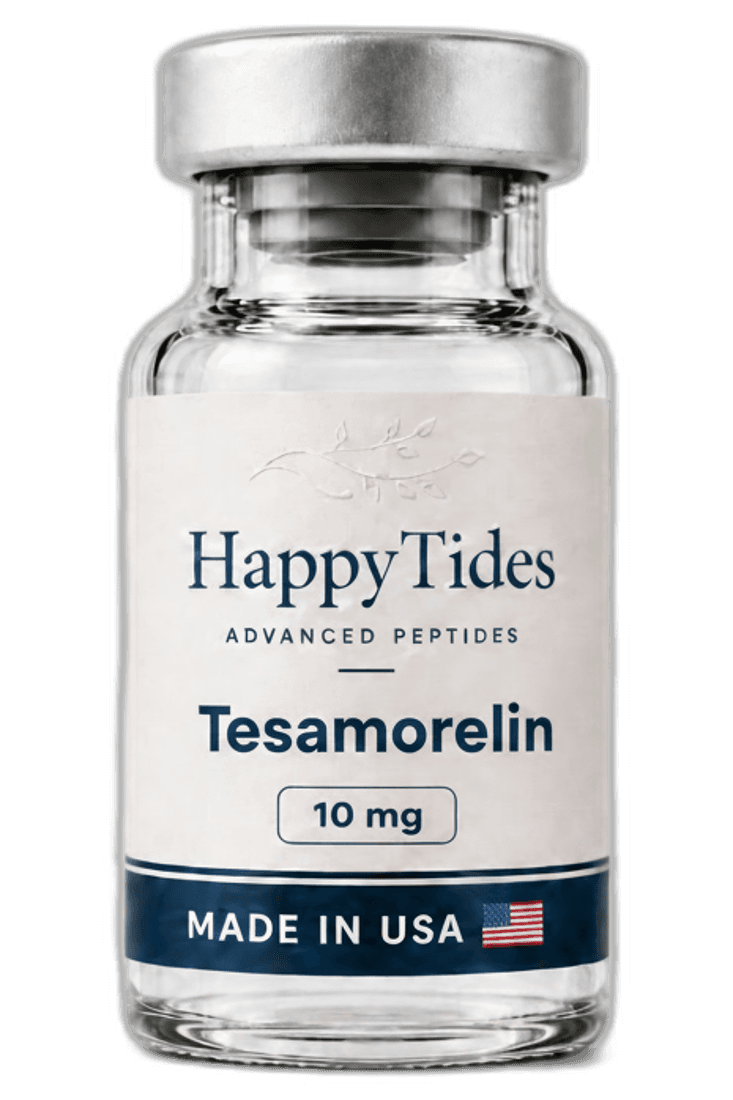
Part of the full Tesamorelin guide - a synthetic growth hormone-releasing hormone reference compound, identity-verified with a COA on every vial.
Straight answers
Tesamorelin, answered
What class of peptide is tesamorelin?
Tesamorelin is a synthetic growth hormone-releasing hormone (GHRH/GRF) analog. The entry describes it as an N-terminally lipid-modified 44-residue peptide and a GHRH receptor (GHRHR) agonist, meaning it is built on the native GHRH scaffold with a stabilizing structural modification.
What is tesamorelin's molecular target?
Its molecular target is the growth hormone-releasing hormone receptor (GHRHR), a class B G-protein-coupled receptor expressed on anterior pituitary somatotroph cells. In receptor-level and cell-based systems, tesamorelin acts as a GHRHR agonist.
What signaling pathway does GHRHR engagement activate?
Per the record, receptor engagement couples to the stimulatory G-protein (Gs), activating adenylyl cyclase and raising intracellular cAMP, which activates protein kinase A (PKA). PKA phosphorylates transcription factors such as CREB, modulating growth-hormone gene transcription and somatotroph secretory-vesicle mobilization, the canonical GHRH signaling cascade.
What is tesamorelin's amino acid sequence?
It is the full native human GHRH(1-44) sequence, one-letter YADAIFTNSYRKVLGQLSARKLLQDIMSRQQGESNQERGARARL, bearing a trans-3-hexenoyl group on the alpha-amino group of N-terminal Tyr1 and a C-terminal amide (-NH2).
What is the molecular weight and formula?
The average molecular weight is 5135.9 g/mol (approximately 5136 Da), and the molecular formula is C221H366N72O67S, both attributed to PubChem CID 16137828 computed properties. The molecular weight is the value used for molar-concentration calculations.
What are tesamorelin's CAS number and other identifiers?
The CAS Registry Number for the free base is 218949-48-5. The PubChem Compound Identifier (CID) is 16137828, and the original development code was TH9507 (TH-9507), recorded from the Falutz et al. 2010 pooled phase 3 analysis.
Why does tesamorelin carry an N-terminal hexenoyl modification?
The N-terminal trans-3-hexenoyl acylation on Tyr1 confers resistance to dipeptidyl peptidase-4 (DPP-4) cleavage, which is the principal route of native GHRH inactivation. This prolongs the molecule's stability while preserving its receptor-binding determinants.
What research areas does the entry associate with tesamorelin?
Listed areas include GHRHR class B GPCR binding and agonist pharmacology; Gs/adenylyl cyclase/cAMP/PKA signal-transduction studies in somatotroph cell models; CREB phosphorylation and growth-hormone gene transcription; DPP-4 enzymatic-stability and degradation kinetics of N-acylated GHRH analogs; structure-activity relationships of N-terminal lipidation; and population/preclinical pharmacokinetic modeling of long-acting GHRH analogs.
Does the entry provide a specific half-life value?
No numeric half-life is provided in the record. The entry supports a degradation-resistance mechanism (N-terminal acylation blocking DPP-4 cleavage to prolong stability) but does not state quantitative pharmacokinetic values, so none should be inferred from this data alone.
How is tesamorelin handled for in-vitro laboratory preparation?
It is supplied lyophilized and reconstituted for research handling by dissolving a known peptide mass in bacteriostatic water to a calculated concentration, using the 5135.9 g/mol molecular weight for molar conversions. As a peptide-class principle, lyophilized solid is stored frozen and reconstituted stock refrigerated and protected from light, with minimal freeze-thaw.
Is tesamorelin intended for human use on this reference?
No. This is a research-use-only reference. All framing is in-vitro, receptor-signaling, and laboratory-research oriented; reconstitution and handling describe laboratory preparation for in-vitro work, not any human dosing or administration protocol.
Which sources are cited for tesamorelin in the entry?
The cited sources are Falutz et al. 2010 (JCEM pooled phase 3 analysis), Tomlinson 2006 (Current Opinion in Investigational Drugs drug evaluation), Dhillon 2011 (Drugs review), Stanley et al. 2014 (JAMA randomized clinical trial), and Gonzalez-Sales et al. 2015 (Clinical Pharmacokinetics population pharmacokinetic analysis).
The fine print: products are sold for laboratory research use only and are not for human or animal consumption. Bodily introduction into humans or animals is strictly prohibited by law. Tesamorelin is not a drug and is not intended to diagnose, treat, cure, or prevent any disease. These statements have not been evaluated by the FDA.