
Tesamorelin Reconstitution Guide
Part of the full Tesamorelin guide - a synthetic growth hormone-releasing hormone reference compound, identity-verified with a COA on every vial.
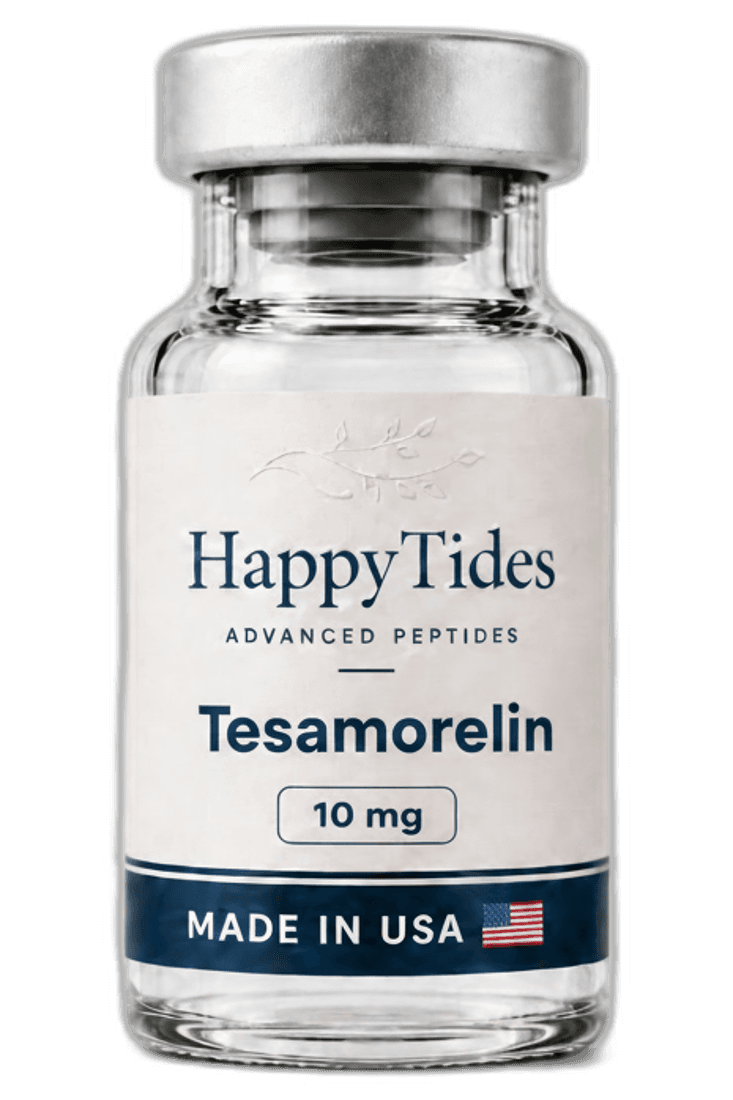
In brief
This section describes laboratory reconstitution of tesamorelin for in-vitro research handling only; it is not a human dosing protocol. Tesamorelin is supplied as a lyophilized (freeze-dried) peptide and, like other research peptides, is dissolved before use in cell-based or receptor-level work. The reconstitution principle is straightforward: a known mass of lyophilized peptide is dissolved in a known volume of solvent, typically bacteriostatic water, to yield a defined working concentration that can be calculated and recorded. With a stated average molecular weight of 5135.9 g/mol (approximately 5136 Da) and molecular formula C221H366N72O67S, tesamorelin's mass is the anchor for converting a target molar concentration into the milligram amount required, or for back-calculating the concentration produced by a given solvent volume. The steps below cover the bacteriostatic-water principle, the concentration math, and storage and stability handling for laboratory preparation, keeping all framing within the in-vitro research context and avoiding any personal-use or administration language.
The detail
A closer look
01
Concentration math from the provided molecular weight
Reconstitution concentration is governed by mass divided by volume. For a vial containing a known mass of lyophilized tesamorelin, dividing that mass by the volume of bacteriostatic water added gives the resulting concentration; for example, dissolving a given milligram amount in a chosen milliliter volume yields a stock expressed in mg/mL. To convert that to a molar concentration for receptor-binding or signaling assays, the average molecular weight of 5135.9 g/mol is used: moles equal grams divided by 5135.9, so a 1 mg/mL stock corresponds to roughly 0.195 mmol/L (since 0.001 g / 5135.9 g/mol is about 1.95 x 10^-7 mol per mL). Researchers typically choose the solvent volume to land on a convenient stock concentration, then record both the mg/mL and molar values. Because the molecular weight is fixed and provided, all such conversions are deterministic and should be documented per preparation.
02
Bacteriostatic-water principle and storage/stability handling
Bacteriostatic water (water containing a small percentage of an antimicrobial preservative such as benzyl alcohol) is the conventional solvent for reconstituting lyophilized research peptides because the preservative suppresses microbial growth in a multi-use vial, supporting stability of the dissolved stock over a working window. Solvent is added gently down the vial wall rather than directly onto the peptide cake to limit mechanical stress, and the vial is swirled, not shaken, until clear. As a class principle for peptides, the lyophilized solid is the most stable form and is kept frozen for long-term storage, while reconstituted aqueous stock is held refrigerated and protected from light, with freeze-thaw cycling minimized to limit degradation. The entry does not provide tesamorelin-specific stability constants, so these handling practices are stated as general peptide-class guidance; researchers should validate stability empirically for their own in-vitro conditions and label each aliquot with concentration and preparation date.
Step by step
How Tesamorelin is reconstituted
A bench reference for handling and preparation in an in-vitro research setting. Not a personal dosing protocol.
- 1
Equilibrate the sealed vial of lyophilized tesamorelin and the bacteriostatic water to room temperature before opening, to limit condensation onto the peptide cake.
- 2
Confirm the labeled peptide mass in the vial and choose a target stock concentration appropriate to the planned in-vitro assay.
- 3
Calculate the required solvent volume: divide the peptide mass by the desired mg/mL concentration to obtain the milliliters of bacteriostatic water to add.
- 4
Draw the calculated volume of bacteriostatic water and introduce it slowly down the inner wall of the vial, allowing it to run onto the peptide rather than impacting it directly.
- 5
Swirl or roll the vial gently until the peptide is fully dissolved and the solution is clear; do not shake or vortex aggressively.
- 6
Convert the resulting mg/mL stock to a molar concentration using the average molecular weight of 5135.9 g/mol (moles = grams / 5135.9) and record both values.
- 7
Aliquot the reconstituted stock into working volumes if frequent access is expected, to reduce repeated freeze-thaw of a single vial.
- 8
Store the reconstituted aqueous stock refrigerated and protected from light, keep any long-term reserve as the lyophilized solid frozen, and label every container with concentration and preparation date for laboratory traceability.
The fine print: products are sold for laboratory research use only and are not for human or animal consumption. Bodily introduction into humans or animals is strictly prohibited by law. Tesamorelin is not a drug and is not intended to diagnose, treat, cure, or prevent any disease. These statements have not been evaluated by the FDA.