
Tesamorelin Half-Life & Stability
Part of the full Tesamorelin guide - a synthetic growth hormone-releasing hormone reference compound, identity-verified with a COA on every vial.
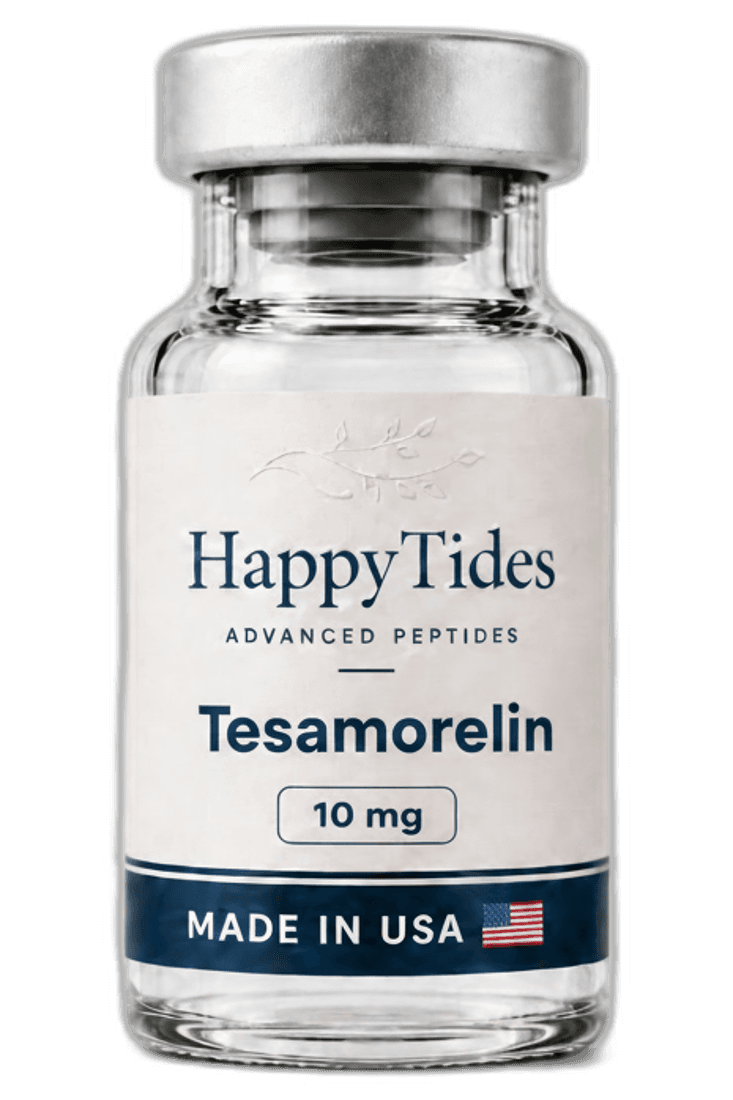
In brief
Tesamorelin's stability and clearance characteristics, as represented in the provided record, are best understood as the product of one deliberate structural choice layered onto general peptide-class behavior. The molecule is a 44-residue GHRH(1-44) analog carrying a trans-3-hexenoyl group on N-terminal Tyr1, and the entry explicitly credits that N-terminal hexenoyl acylation with conferring resistance to dipeptidyl peptidase-4 (DPP-4) cleavage, described as the principal route of native GHRH inactivation. By shielding the N-terminus from DPP-4, the modification prolongs the molecule's stability relative to unmodified GHRH while preserving its receptor-binding determinants. The provided data do not state a numeric half-life value for tesamorelin, so this section does not assign one; instead it describes the degradation-resistance mechanism that the record does support and frames the remaining pharmacokinetic and storage characteristics in general peptide-class terms, clearly flagging where peptide-specific quantitative data are absent from the entry.
The detail
A closer look
01
Degradation resistance built into the structure
The entry's clearest stability statement is mechanistic rather than numeric. Native GHRH is inactivated principally by DPP-4, an exopeptidase acting at the peptide N-terminus. Tesamorelin's trans-3-hexenoyl acylation on the alpha-amino group of Tyr1 occupies and protects that exact N-terminal position, which the record states confers resistance to DPP-4 cleavage and thereby prolongs the molecule's stability. This is a degradation-route argument: the dominant inactivation pathway for the parent peptide is blocked by design, so the analog should persist longer against that enzyme than native GHRH would. Importantly, the entry frames this as enhanced stability while preserving receptor-binding determinants, meaning resistance to proteolysis does not come at the cost of GHRHR engagement. The research areas reinforce this by listing DPP-4 enzymatic-stability and peptide-degradation kinetics of N-acylated GHRH analogs as a studied topic.
02
Pharmacokinetic modeling context and general storage principles
The record lists population/preclinical pharmacokinetic modeling of long-acting GHRH analogs as a research area, with Gonzalez-Sales et al. 2015 in Clinical Pharmacokinetics cited as a population pharmacokinetic analysis. The entry, however, supplies no specific half-life, clearance, or volume-of-distribution values, so none are stated here. For storage and stability outside the body, general peptide-class principles apply: the lyophilized solid is the most stable form and is held frozen for long-term storage, while a reconstituted aqueous stock is kept refrigerated, protected from light, and subjected to minimal freeze-thaw cycling to limit degradation. These are class-level practices, not tesamorelin-specific stability constants, because the entry does not report measured shelf-life or degradation rates. Researchers requiring quantitative pharmacokinetic or stability parameters should derive them empirically or from the cited pharmacokinetic source rather than infer them from this record.
The fine print: products are sold for laboratory research use only and are not for human or animal consumption. Bodily introduction into humans or animals is strictly prohibited by law. Tesamorelin is not a drug and is not intended to diagnose, treat, cure, or prevent any disease. These statements have not been evaluated by the FDA.