
NAD+ Mechanism of Action
Part of the full NAD+ guide - a pyridine dinucleotide redox coenzyme reference compound, identity-verified with a COA on every vial.
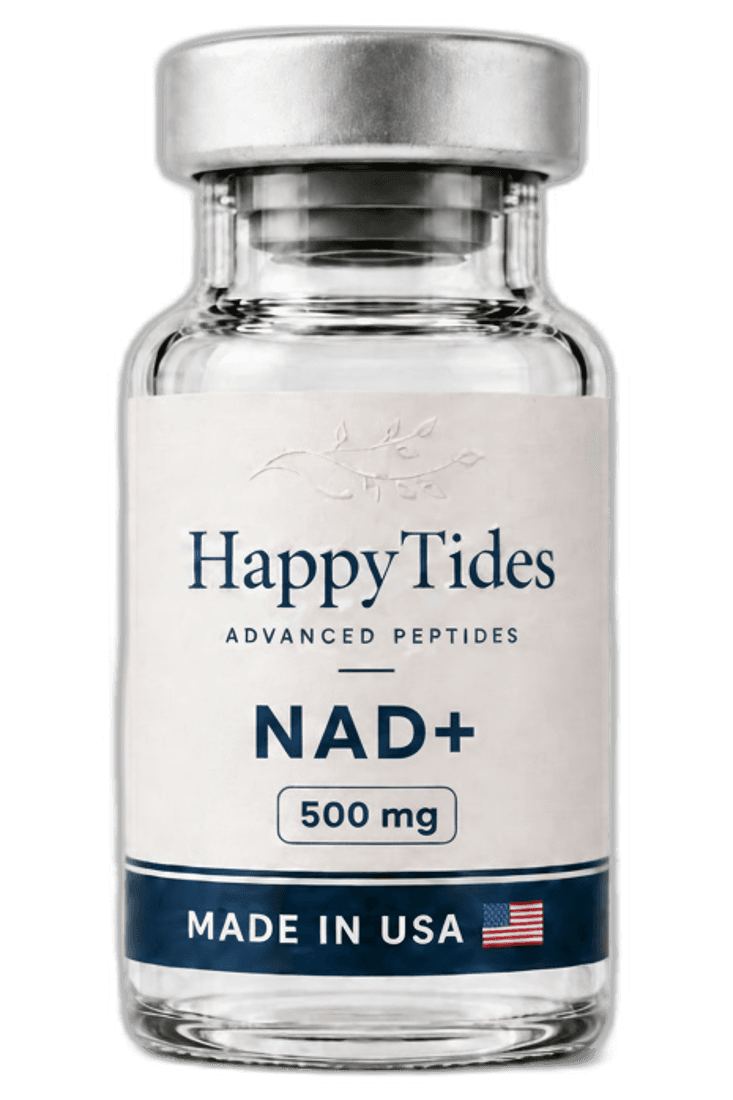
In brief
NAD+ (nicotinamide adenine dinucleotide, CAS 53-84-9, C21H27N7O14P2, 663.43 g/mol) functions in two mechanistically distinct registers that researchers track in cell-free and cell-based systems: as a redox electron carrier and as a stoichiometrically consumed signaling co-substrate. Both registers are characterized here purely at the molecular and signal-transduction level, with no therapeutic or human-outcome framing.
The detail
A closer look
01
Redox couple: NAD+/NADH electron shuttling
In its redox role NAD+ acts as an electron acceptor that cycles between oxidized (NAD+) and reduced (NADH) forms, shuttling reducing equivalents through three connected metabolic modules studied in vitro: glycolysis, the citric-acid cycle, and oxidative phosphorylation. Because the NAD+/NADH couple is the vehicle that moves hydride/electron equivalents between these pathways, the ratio of the two forms is itself a measurable laboratory readout of the redox state of a given preparation. This electron-carrier behavior is non-consumptive - the coenzyme is regenerated as it cycles - which distinguishes it sharply from the signaling reactions below.
02
Sirtuin deacylase co-substrate (SIRT1–7)
Beyond redox chemistry, NAD+ is the obligatory co-substrate consumed by the sirtuin deacylase family (SIRT1 through SIRT7). In these reactions NAD+ hydrolysis is mechanistically coupled to protein deacetylation, and the sirtuin literature links this activity to mitochondrial-biogenesis transcription as a studied downstream readout. Critically, sirtuins consume NAD+ stoichiometrically rather than cycling it, so each catalytic turnover draws down the available NAD+ pool - making intracellular NAD+ availability an experimental variable in its own right within sirtuin assays.
03
PARP and CD38/cADPR signaling arms
Two further NAD+-consuming enzyme families serve as the other principal mechanistic readouts in the entry's data. The poly-ADP-ribose polymerases (PARPs) use NAD+ as substrate in DNA-damage-response signaling, and the CD38/cADPR (cyclic ADP-ribose) pathway draws on NAD+ in calcium-signaling contexts. Together with the sirtuins, these enzymes establish NAD+ as a hub where redox chemistry and post-translational/second-messenger signaling intersect. Because all three families deplete NAD+ stoichiometrically, the convergence point of every pathway in this section is the same studied quantity: the size and turnover of the cellular NAD+ pool.
The fine print: products are sold for laboratory research use only and are not for human or animal consumption. Bodily introduction into humans or animals is strictly prohibited by law. NAD+ is not a drug and is not intended to diagnose, treat, cure, or prevent any disease. These statements have not been evaluated by the FDA.