
NAD+ - Frequently Asked Questions
Part of the full NAD+ guide - a pyridine dinucleotide redox coenzyme reference compound, identity-verified with a COA on every vial.
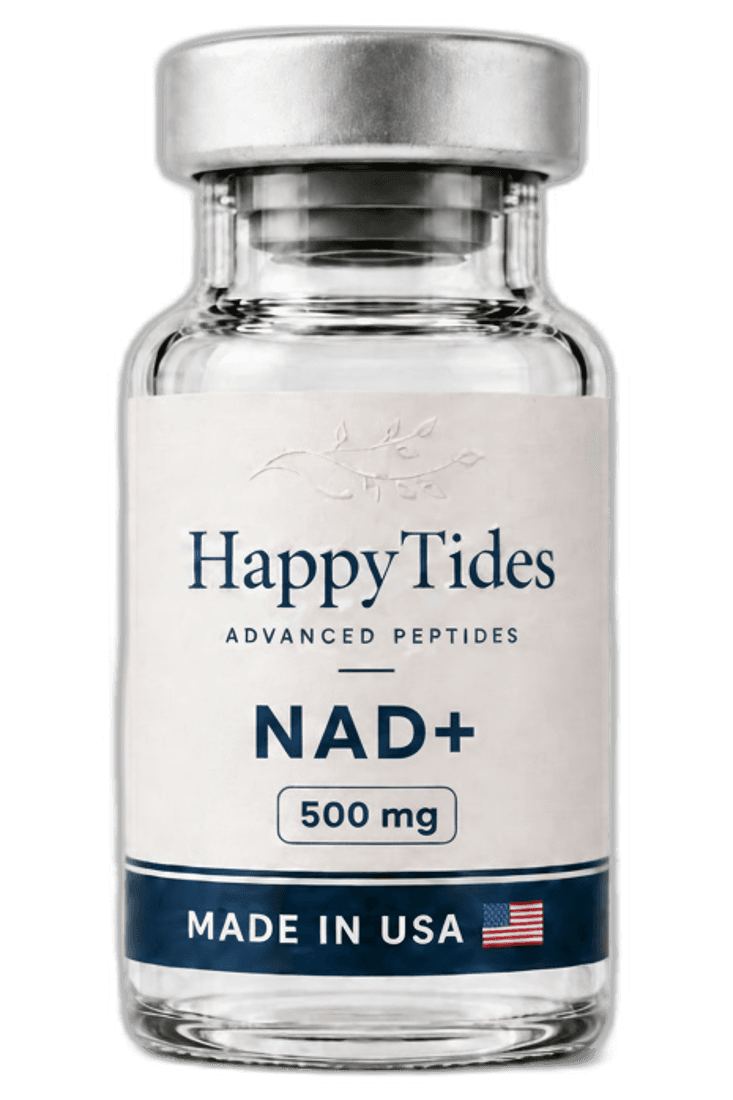
Straight answers
NAD+, answered
Is NAD+ a peptide?
No. The entry classifies NAD+ as a pyridine dinucleotide redox coenzyme and sirtuin/PARP co-substrate - explicitly "not a peptide - a nucleotide cofactor." Its sequence field reads "n/a" because it is built from two nucleotides (adenine and nicotinamide mononucleotides joined by a pyrophosphate bridge), not from an amino-acid chain.
What are the core molecular identifiers for NAD+?
Molecular formula C21H27N7O14P2, molecular weight 663.43 g/mol (sourced to PubChem CID 5892), and CAS number 53-84-9. These are the identity descriptors used for reagent sourcing, chain-of-custody, and reconstitution concentration math.
What is the NAD+/NADH redox couple?
It is the oxidized/reduced pair through which NAD+ acts as an electron acceptor, cycling between NAD+ and NADH to shuttle reducing equivalents through glycolysis, the citric-acid cycle, and oxidative phosphorylation. This redox cycling is non-consumptive - the coenzyme is regenerated as it cycles.
Which enzyme families consume NAD+ as a co-substrate?
Three families studied as readouts in the entry: the sirtuin deacylases (SIRT1–7), which couple NAD+ hydrolysis to protein deacetylation and mitochondrial-biogenesis transcription; the poly-ADP-ribose polymerases (PARPs), which use NAD+ in DNA-damage-response signaling; and CD38/cADPR pathways in calcium signaling. All three consume NAD+ stoichiometrically.
Why is intracellular NAD+ availability described as a studied variable?
Because sirtuins, PARPs, and CD38/cADPR enzymes consume NAD+ stoichiometrically rather than cycling it, each catalytic turnover draws down the NAD+ pool. That makes the size and turnover of the available NAD+ pool an experimental variable in its own right, not a fixed background constant.
What research areas does the entry list for NAD+?
Three: mitochondrial-respiration and oxidative-phosphorylation models; sirtuin (SIRT1–7) deacylase activity and cellular-aging studies; and PARP-mediated DNA-damage-response and genotoxic-stress assays. Each maps onto one of the redox or co-substrate roles described in the mechanism.
What sources are cited in the entry?
Two. Gomes, A. P., et al. (Sinclair lab), 2013, Cell - "Declining NAD+ induces a pseudohypoxic state disrupting nuclear-mitochondrial communication during aging" (DOI 10.1016/j.cell.2013.11.037; PMID 24360282). And Yoshino, J., Baur, J. A., Imai, S., 2018, Cell Metabolism - "NAD+ intermediates: the biology and therapeutic potential of NMN and NR" (DOI 10.1016/j.cmet.2017.11.002; PMID 29249689).
How is the molecular weight used in laboratory reconstitution?
The 663.43 g/mol value is the conversion factor for molar calculations: moles = mass (g) / 663.43, and stock concentration = mass of solute / diluent volume. The diluent volume is back-calculated from the labeled vial mass to reach a defined target concentration for in-vitro use.
What diluent is used to reconstitute a lyophilized NAD+ reagent?
Bacteriostatic water is the conventional diluent for laboratory reconstitution because its preservative limits microbial growth across repeated vial entries. It is added slowly down the vial wall, not jetted onto the powder, and the solution is swirled gently rather than shaken or vortexed aggressively. This is a benchtop preparation principle, not a human dosing protocol.
Does the entry provide a half-life or stability figure for NAD+?
No. The entry provides no NAD+-specific pharmacokinetic half-life, in-solution stability constant, or degradation-rate value. The only stability-relevant property supplied is structural - the pyrophosphate bridge defines the intact dinucleotide. Any storage guidance beyond that is stated as general lyophilized-cofactor handling practice, not an NAD+-specific measurement.
What does the pyrophosphate bridge contribute structurally?
The pyrophosphate bridge is the linkage that joins the adenine mononucleotide to the nicotinamide mononucleotide, forming the intact NAD+ coenzyme. It corresponds to the two phosphorus atoms in the formula C21H27N7O14P2. The nicotinamide end is the redox-active moiety behind the NAD+/NADH couple, while the adenine half supports enzyme recognition.
How should a reconstituted NAD+ stock be stored in the laboratory?
As general cofactor-reagent practice (not an NAD+-specific measured shelf life): keep the dry lyophilate sealed, cool, and desiccated until use; hold reconstituted stock refrigerated and protected from light; and aliquot to minimize repeated freeze–thaw cycles and repeated septum entry, both generic degradation and contamination vectors. The entry does not quantify a specific decay rate.
The fine print: products are sold for laboratory research use only and are not for human or animal consumption. Bodily introduction into humans or animals is strictly prohibited by law. NAD+ is not a drug and is not intended to diagnose, treat, cure, or prevent any disease. These statements have not been evaluated by the FDA.