
GHK-Cu Specs: Sequence, MW & CAS
Part of the full GHK-Cu guide - a copper-binding tripeptide reference compound, identity-verified with a COA on every vial.
In brief
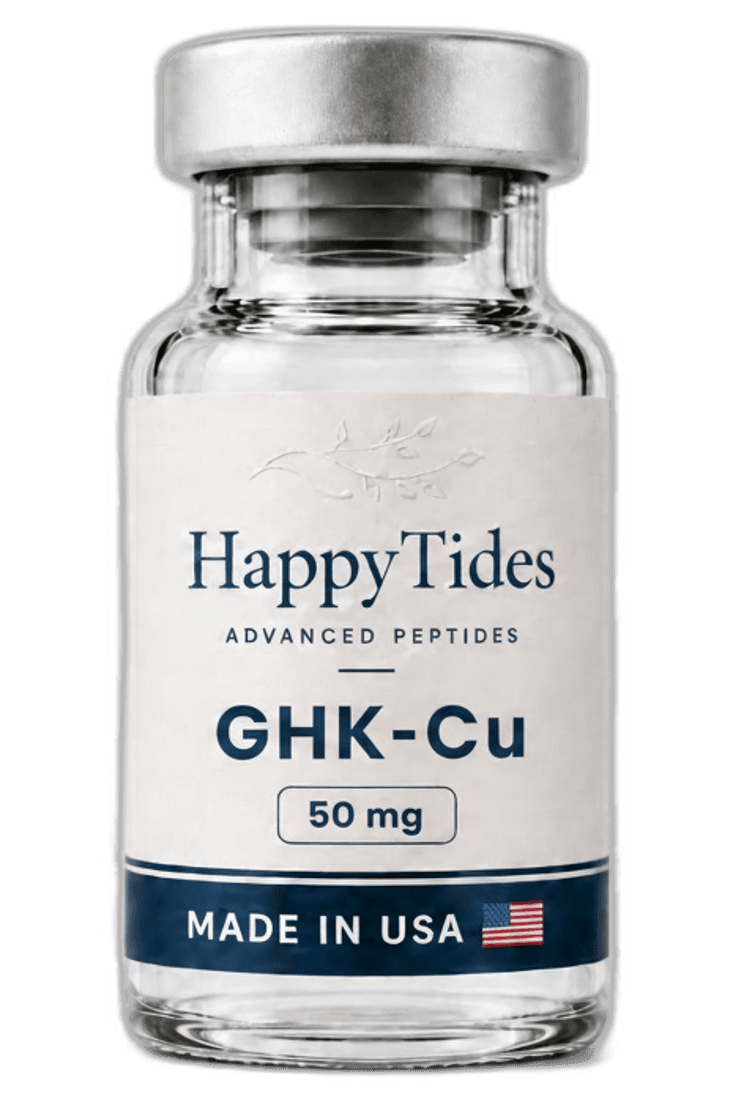
GHK-Cu's specification block tells a two-molecule story that researchers should keep straight: there is the free tripeptide and there is the copper complex, and the numbers differ. The free GHK tripeptide is glycyl-L-histidyl-L-lysine, molecular formula C14H24N6O4, molecular weight 340.38 g/mol, CAS 72957-37-0. The 1:1 Cu(II) complex is C14H22CuN6O4, 401.91 g/mol, with the commonly cited CAS 49557-75-7 (and 89030-95-5 also registered for the Cu(II) complex). The peptide class is a copper-binding tripeptide / metal-peptide coordination complex described as a matricellular signaling peptide. The sections below interpret what the sequence, the two molecular weights, the formula difference, and the multiple CAS numbers actually mean for identity and structure-function - all drawn from the provided identifiers, with no fabricated structural data.
To the molecule
Molecular specifications
Gly-His-Lys (GHK); one-letter GHK, complexed 1:1 with Cu(II)The detail
A closer look
01
Sequence and structure-function
The sequence is Gly-His-Lys (one-letter GHK), a three-residue chain complexed 1:1 with Cu(II). Each residue carries a defined role in the structure-function logic set out by Lau and Sarkar. Histidine supplies the imidazole nitrogen donor, the N-terminal glycine supplies the alpha-amino nitrogen and the amide nitrogen that deprotonates upon copper binding, and lysine's epsilon-amino group raises the stability of the assembled complex. So the short sequence is not incidental: each amino acid contributes a specific chemical feature to copper coordination. This is why the entry classes GHK-Cu as a metal-peptide coordination complex rather than a simple peptide - the biological identity of the molecule is inseparable from the metal it carries and the geometry in which that metal is held.
02
Two molecular weights and the formula difference
The specification lists two molecular weights because there are two distinct chemical entities. Free GHK is C14H24N6O4 at 340.38 g/mol; the 1:1 Cu(II) complex is C14H22CuN6O4 at 401.91 g/mol. Comparing the formulas shows the chemistry of complexation: the carbon, nitrogen, and oxygen counts are conserved (C14, N6, O4), copper is added, and two hydrogens are lost - consistent with deprotonation events accompanying copper coordination, including the deprotonated Gly-His amide nitrogen described in the mechanism. The ~61 g/mol mass increase reflects the bound copper minus those displaced protons. For laboratory math this distinction is load-bearing: molar calculations for the active complex must use 401.91 g/mol, because using the free-peptide weight would misstate the concentration of the species actually being studied.
03
CAS numbers and registry identity
GHK-Cu carries more than one registry identifier, which the specification documents to prevent confusion. The commonly cited CAS for GHK-Cu is 49557-75-7, while 89030-95-5 is also registered for the Cu(II) complex, and the free GHK tripeptide has its own CAS, 72957-37-0. Multiple registry numbers for a metal-peptide system are not unusual: they can reflect different registered forms or sourcing of the same complex, and supplier listings (per the entry's source hints, including CymitQuimica under 89030-95-5) show this directly. The practical takeaway for researchers is to confirm which entity a given identifier denotes - free peptide versus copper complex - when cross-referencing datasheets, since the two share the GHK backbone but differ in formula, molecular weight, and intended use as a coordination complex.
The fine print: products are sold for laboratory research use only and are not for human or animal consumption. Bodily introduction into humans or animals is strictly prohibited by law. GHK-Cu is not a drug and is not intended to diagnose, treat, cure, or prevent any disease. These statements have not been evaluated by the FDA.