
GHK-Cu - Frequently Asked Questions
Part of the full GHK-Cu guide - a copper-binding tripeptide reference compound, identity-verified with a COA on every vial.
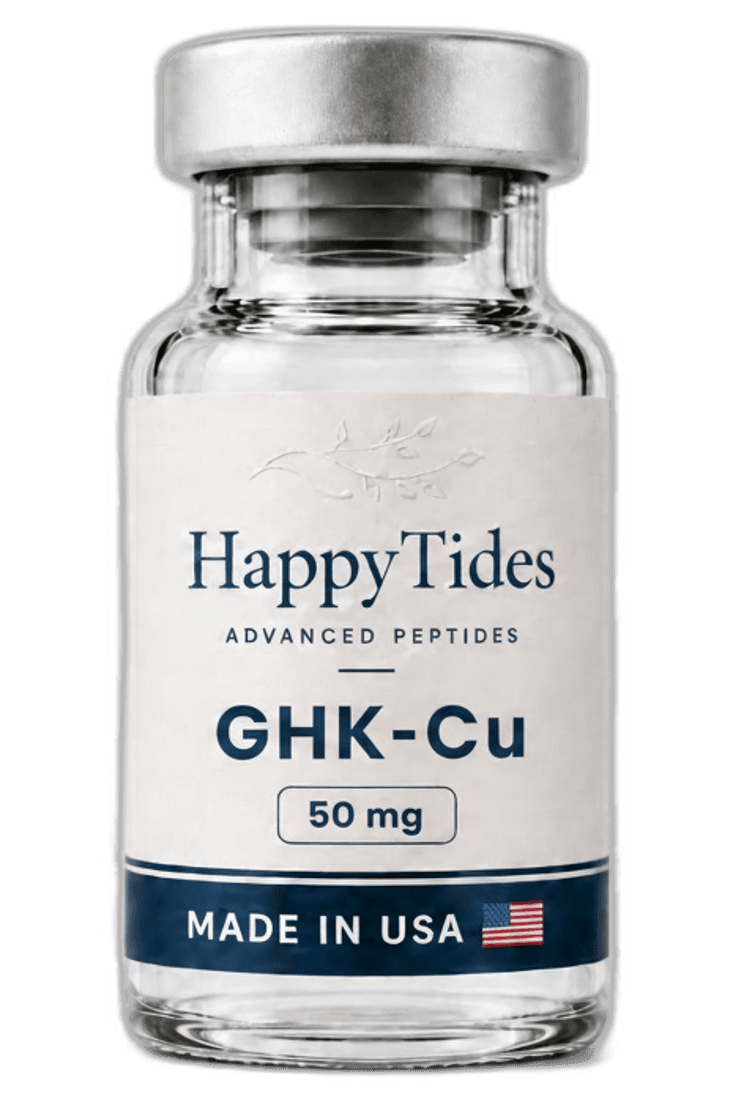
Straight answers
GHK-Cu, answered
What chemical class does GHK-Cu belong to?
It is a copper-binding tripeptide and metal-peptide coordination complex, described as a matricellular signaling peptide. Functionally it is the 1:1 coordination complex of the glycyl-L-histidyl-L-lysine tripeptide with a Cu(II) ion.
What is the amino acid sequence of GHK?
The sequence is Gly-His-Lys (glycyl-L-histidyl-L-lysine), one-letter code GHK. In GHK-Cu it is complexed 1:1 with Cu(II).
How is the copper held in the complex?
Per Lau and Sarkar (PMID 7340824), Cu(II) is coordinated by the histidine imidazole nitrogen, the glycine alpha-amino nitrogen, and the deprotonated glycyl-histidyl amide nitrogen, with the lysine epsilon-amino group raising complex stability.
What is the molecular weight of GHK-Cu versus free GHK?
The 1:1 Cu(II) complex (C14H22CuN6O4) is 401.91 g/mol. The free GHK tripeptide (C14H24N6O4) is 340.38 g/mol. Use 401.91 g/mol for molar calculations involving the copper complex.
What is the CAS number for GHK-Cu?
The commonly cited CAS is 49557-75-7, and 89030-95-5 is also registered for the Cu(II) complex. The free GHK tripeptide has a separate CAS, 72957-37-0.
What does the in-vitro research on GHK-Cu actually investigate?
The provided citations cover copper(II) coordination chemistry (Lau & Sarkar), collagen I/III synthesis in fibroblast cultures (Maquart, PMID 3169264), MMP-2/TIMP-1/TIMP-2 expression in fibroblasts (Simeon, PMID 11045606), and transcriptomic gene-set modulation via Connectivity Map analysis (Pickart & Margolina, PMID 29986520; Pickart et al. 2015).
At what concentration was maximal collagen stimulation reported in fibroblast culture?
Maquart et al. (PMID 3169264) reported maximal collagen-synthesis stimulation near 10^-9 M (nanomolar) in fibroblast cultures, an effect independent of changes in cell number.
Is the MMP-2 effect due to the peptide or the copper?
Simeon et al. (PMID 11045606) attributed the coordinate upregulation of MMP-2 (alongside TIMP-1 and TIMP-2) to the copper moiety rather than to the apo-peptide.
Where does GHK come from?
GHK was isolated from human plasma by Loren Pickart in 1973 and identified as a growth-modulating tripeptide. It is reported to occur naturally in human plasma, saliva, and urine (Pickart & Margolina, PMID 29986520).
How broad is the gene modulation reported for GHK?
In the Connectivity Map analysis reported by Pickart and Margolina (PMID 29986520), GHK is described as affecting roughly 31.2% of human genes by at least 50% expression change, spanning extracellular-matrix remodeling, antioxidant response, TGF-beta signaling, and DNA-repair gene sets.
How is GHK-Cu reconstituted for laboratory work?
For in-vitro research only, lyophilized GHK-Cu is dissolved in bacteriostatic water to a calculated stock concentration using 401.91 g/mol, then serially diluted into assay medium. This is laboratory preparation, not a human dosing protocol.
Is there a documented half-life for GHK-Cu, and what is its use status?
The provided data includes no peptide-specific half-life, clearance, or degradation rate; stability handling follows general peptide-class precautions (cold, aliquoted, lyophilized storage; minimized freeze-thaw). GHK-Cu is described strictly for research use only, with all findings framed as in-vitro signaling and gene-expression observations and no therapeutic or human-use claims.
The fine print: products are sold for laboratory research use only and are not for human or animal consumption. Bodily introduction into humans or animals is strictly prohibited by law. GHK-Cu is not a drug and is not intended to diagnose, treat, cure, or prevent any disease. These statements have not been evaluated by the FDA.