
GHK-Cu Half-Life & Stability
Part of the full GHK-Cu guide - a copper-binding tripeptide reference compound, identity-verified with a COA on every vial.
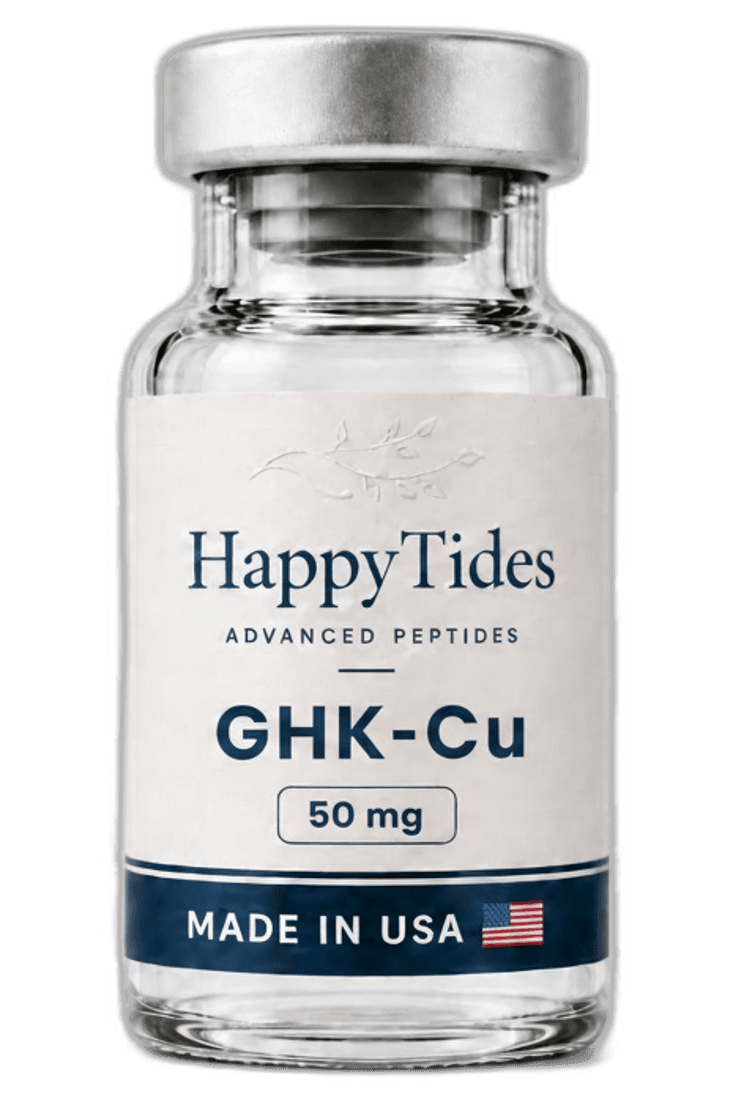
In brief
GHK-Cu's stability and pharmacokinetic-style behavior must be discussed carefully here, because the provided entry contains no peptide-specific half-life, clearance, or in-vivo degradation values. What the data does establish is structural: GHK-Cu is a small tripeptide-copper coordination complex (401.91 g/mol) whose function depends on copper being held by a defined donor set (Lau & Sarkar, PMID 7340824). From that, and from general peptide-class principles, we can reason about stability and storage in a laboratory context without inventing numbers. The discovery data also notes that the parent GHK tripeptide occurs naturally in human plasma, saliva, and urine (Pickart & Margolina, PMID 29986520), which is relevant context for an endogenous small peptide. The sections below separate what is supported by the entry from what is general peptide-class expectation, and flag clearly where no peptide-specific figure is available.
The detail
A closer look
01
What the data supports about stability
The entry supports a structural rather than kinetic picture. GHK-Cu is the 1:1 coordination complex, and its activity in the cited fibroblast assays is tied to the intact holo-complex: Maquart's collagen response and Simeon's copper-attributed MMP-2 effect both describe the assembled complex, and Simeon specifically distinguishes the copper moiety from the apo-peptide. The practical stability implication is that maintaining the coordination state - copper held by the histidine imidazole, glycine alpha-amino, and deprotonated Gly-His amide nitrogens, stabilized by the lysine epsilon-amino group - is what preserves the active species in vitro. The entry provides no measured half-life, dissociation rate, or shelf-life figure, so any statement about how long the complex persists must be treated as unquantified by the provided data and handled through general precaution rather than a specific number.
02
General peptide-class principles
In the absence of GHK-Cu-specific kinetic data, only general small-peptide principles apply, and they should be read as class-level expectations rather than measured values. Small peptides are generally susceptible to enzymatic and chemical degradation in solution, which is why lyophilized storage is favored and why reconstituted stocks are typically kept cold, aliquoted, and protected from repeated freeze-thaw. Light, heat, and air exposure are common degradation accelerants for peptide solutions at the bench. For a metal-peptide complex specifically, preserving the chelation environment is an added consideration on top of ordinary peptide handling. None of these are quantified for GHK-Cu in the provided entry; they are offered explicitly as general handling logic to fill the gap left by the absence of peptide-specific stability or pharmacokinetic figures.
The fine print: products are sold for laboratory research use only and are not for human or animal consumption. Bodily introduction into humans or animals is strictly prohibited by law. GHK-Cu is not a drug and is not intended to diagnose, treat, cure, or prevent any disease. These statements have not been evaluated by the FDA.