
GHK-Cu Mechanism of Action
Part of the full GHK-Cu guide - a copper-binding tripeptide reference compound, identity-verified with a COA on every vial.
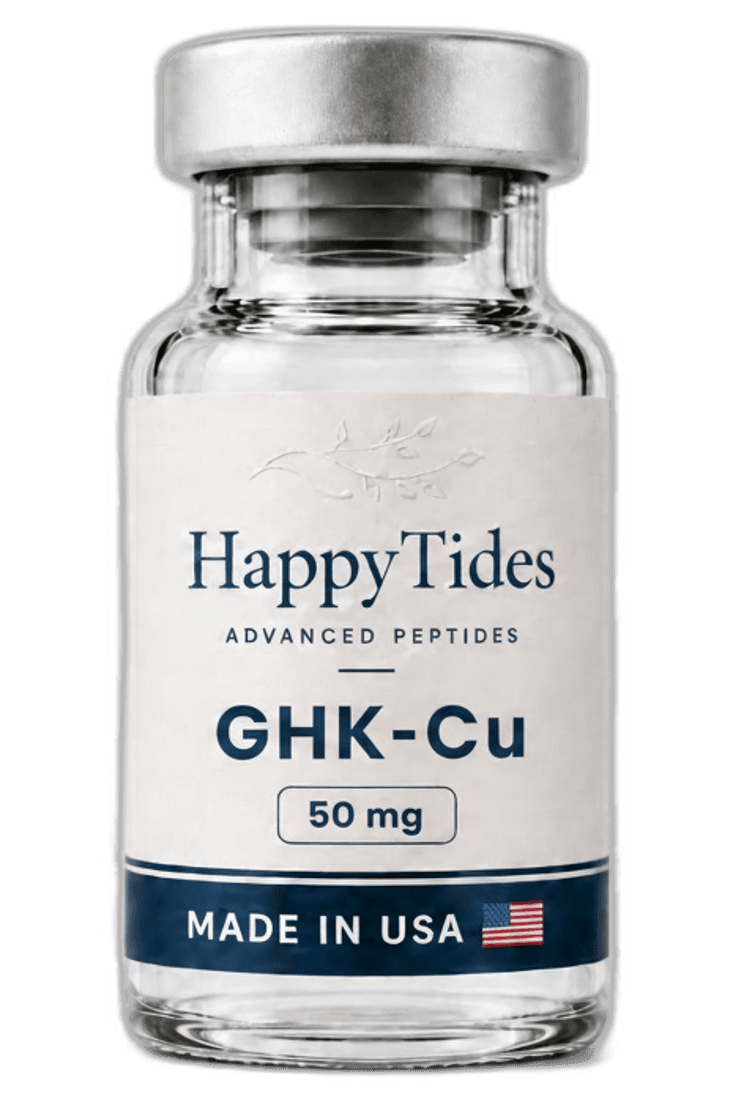
In brief
GHK-Cu is best understood as a coordination complex first and a signaling molecule second: the glycyl-L-histidyl-L-lysine tripeptide wrapped around a single Cu(II) ion in 1:1 stoichiometry. The provided mechanism data anchors every downstream effect to how that copper is held. According to Lau and Sarkar (Biochem J 199:649-656, PMID 7340824), the metal sits in a defined donor set rather than loosely associated charge, and that geometry is what distinguishes the holo-complex from the apo-peptide in fibroblast culture work. The sections below expand the coordination chemistry, the collagen-gene response mapped by Maquart et al. (PMID 3169264), the metalloproteinase-balance signaling described by Simeon et al. (PMID 11045606), and the broad transcriptomic footprint reported by Pickart and Margolina (PMID 29986520) - all framed strictly as in-vitro receptor-signaling and gene-expression observations, never as physiological or therapeutic outcomes.
The detail
A closer look
01
Copper coordination defines the active species
The defining molecular event is chelation. Lau and Sarkar (PMID 7340824) describe Cu(II) coordinated by the imidazole nitrogen of histidine, the alpha-amino nitrogen of the N-terminal glycine, and the deprotonated glycyl-histidyl amide nitrogen, while the lysine epsilon-amino group raises the stability of the assembled complex. This is a high-affinity, geometrically specific arrangement, not a casual ionic pairing. Because the donor atoms come from three different residues, the tripeptide effectively clamps the metal into a fixed environment. The provided data frames the consequence directly: this chelation lets GHK behave as a copper carrier and modulates copper redox availability in the in-vitro setting. The complex therefore acts as a vehicle that controls where and how reactive the copper is, which is the structural basis for separating holo-complex behavior from free peptide behavior in the downstream assays.
02
Collagen gene and protein upregulation in fibroblasts
Maquart et al. (PMID 3169264) reported that in cultured dermal fibroblasts, GHK-Cu stimulates expression of collagen type I and type III at both the gene and protein level. The provided data emphasizes two qualifiers that sharpen the mechanistic reading. First, the maximal effect occurs near nanomolar concentration (approximately 10^-9 M), implying a high-affinity, saturable interaction rather than a bulk dose-driven push. Second, the stimulation is independent of changes in cell number, meaning the observation reflects per-cell transcriptional and translational upregulation rather than simply more fibroblasts producing baseline collagen. Mechanistically, this positions GHK-Cu as a signal that shifts the matrix-synthesis program of an existing cell population in vitro, consistent with a matricellular signaling role rather than a mitogenic one.
03
Metalloproteinase balance is copper-dependent
Simeon et al. (PMID 11045606) extended the mechanism beyond synthesis into matrix turnover, showing that GHK-Cu coordinately upregulates matrix metalloproteinase-2 (MMP-2) together with its tissue inhibitors TIMP-1 and TIMP-2 in fibroblast cultures. The provided data adds a crucial attribution: the MMP-2 effect is ascribed to the copper moiety rather than to the apo-peptide. This is mechanistically informative because it separates the two halves of the molecule by function. The peptide scaffold governs recognition and delivery, while the bound copper drives the MMP-2 response. The coordinated rise of both protease and inhibitors describes a signaling pattern oriented toward regulated extracellular-matrix remodeling in vitro, where degradation and inhibition are modulated together rather than degradation alone.
04
A broad transcriptomic signature
Beyond individual genes, Pickart and Margolina (PMID 29986520) used Connectivity Map data to profile GHK as a modulator of a wide gene set. The provided data specifies that this footprint spans extracellular-matrix remodeling, antioxidant response, TGF-beta signaling, and DNA-repair pathways, and that GHK is reported to affect roughly 31.2% of human genes by at least 50% expression change in that analysis. Mechanistically this reframes GHK-Cu from a single-pathway agonist into a broad transcriptional modulator. The matricellular peptide class designation fits this breadth: rather than binding one receptor to trigger one cascade, the in-vitro data describes coordinated shifts across multiple gene programs. All of this is reported strictly as gene-expression observation, not as demonstrated cellular or organismal function.
The fine print: products are sold for laboratory research use only and are not for human or animal consumption. Bodily introduction into humans or animals is strictly prohibited by law. GHK-Cu is not a drug and is not intended to diagnose, treat, cure, or prevent any disease. These statements have not been evaluated by the FDA.