
GHK-Cu Reconstitution Guide
Part of the full GHK-Cu guide - a copper-binding tripeptide reference compound, identity-verified with a COA on every vial.
In brief
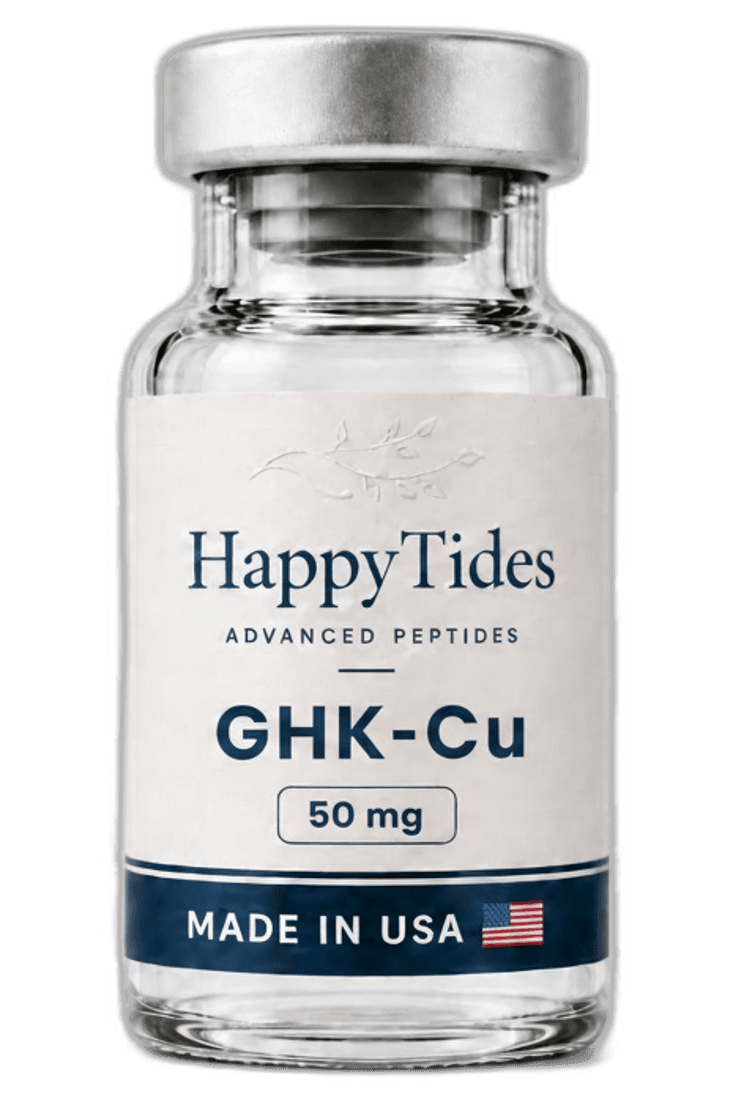
This section describes laboratory reconstitution of lyophilized GHK-Cu for in-vitro research handling only - it is not a human dosing protocol and contains no personal-use instructions. GHK-Cu is supplied as a dried (lyophilized) solid and must be brought into solution before it can be used in cell-culture or analytical work. Reconstitution math is governed by the complex's molecular weight: 401.91 g/mol for the 1:1 Cu(II) complex (C14H22CuN6O4), versus 340.38 g/mol for the free GHK tripeptide (C14H24N6O4). Because the Maquart fibroblast data places maximal collagen-synthesis stimulation near 10^-9 M, researchers typically prepare a concentrated stock and serially dilute into assay medium to reach nanomolar working ranges. Bacteriostatic water is the standard reconstitution diluent for benchtop handling. The notes and ordered steps below cover the dilution principle, concentration calculation, and stability/storage considerations for the laboratory only.
The detail
A closer look
01
Reconstitution and concentration principle
Reconstitution means dissolving a known mass of lyophilized GHK-Cu in a known volume of diluent so the resulting concentration is calculable. The core relationship is concentration = mass / volume. For molar concentrations, convert mass to moles using 401.91 g/mol for the Cu(II) complex; using the free-peptide weight of 340.38 g/mol would misstate the molar concentration of the holo-complex. Bacteriostatic water (water with a bacteriostatic preservative) is the conventional diluent because it discourages microbial growth in a stock that may be sampled repeatedly. A practical approach is to prepare a relatively concentrated stock - for example, dissolving a measured quantity in a measured volume to yield a millimolar or micromolar stock - then serially dilute into culture medium to reach the nanomolar working range indicated by the Maquart in-vitro data. Always record the exact mass and volume so the molarity of every dilution step is traceable.
02
Stability and storage handling
As a copper-coordination complex, GHK-Cu's defining feature is the metal held by the peptide donor set described by Lau and Sarkar, so laboratory handling should protect that coordination state. General good practice for reconstituted peptide stocks applies: keep solutions cold, minimize freeze-thaw cycling by aliquoting, and limit prolonged exposure to light, heat, and air at the bench. Lyophilized material is generally more stable than solution, so reconstitute only what an experiment requires and keep the balance dry and cold. Because the provided data does not specify a peptide-specific shelf life or degradation rate for GHK-Cu, storage windows should be treated as general peptide-class precautions rather than validated figures, and any working solution should be labeled with preparation date and nominal concentration for in-vitro tracking.
Step by step
How GHK-Cu is reconstituted
A bench reference for handling and preparation in an in-vitro research setting. Not a personal dosing protocol.
- 1
Allow the sealed vial of lyophilized GHK-Cu to equilibrate to room temperature before opening to limit condensation onto the dry powder.
- 2
Calculate the target stock concentration using 401.91 g/mol (the 1:1 Cu(II) complex molecular weight), not the 340.38 g/mol free-peptide weight, so the molarity reflects the holo-complex.
- 3
Determine the bacteriostatic-water volume needed for the chosen stock concentration from concentration = mass / volume (e.g., volume = mass / desired concentration).
- 4
Add the bacteriostatic water slowly down the inside wall of the vial rather than directly onto the powder, and let it dissolve gently without vigorous shaking.
- 5
Swirl or roll the vial until fully dissolved; record the exact mass and volume used so every downstream dilution is traceable.
- 6
Serially dilute the stock into assay medium to reach the nanomolar working range indicated by the in-vitro fibroblast data.
- 7
Aliquot the stock to minimize repeated freeze-thaw cycles, store cold and protected from light/heat/air, and label each aliquot with concentration and preparation date for laboratory tracking.
The fine print: products are sold for laboratory research use only and are not for human or animal consumption. Bodily introduction into humans or animals is strictly prohibited by law. GHK-Cu is not a drug and is not intended to diagnose, treat, cure, or prevent any disease. These statements have not been evaluated by the FDA.