
BPC-157 Mechanism of Action
Part of the full BPC-157 guide - a synthetic pentadecapeptide reference compound, identity-verified with a COA on every vial.
In brief
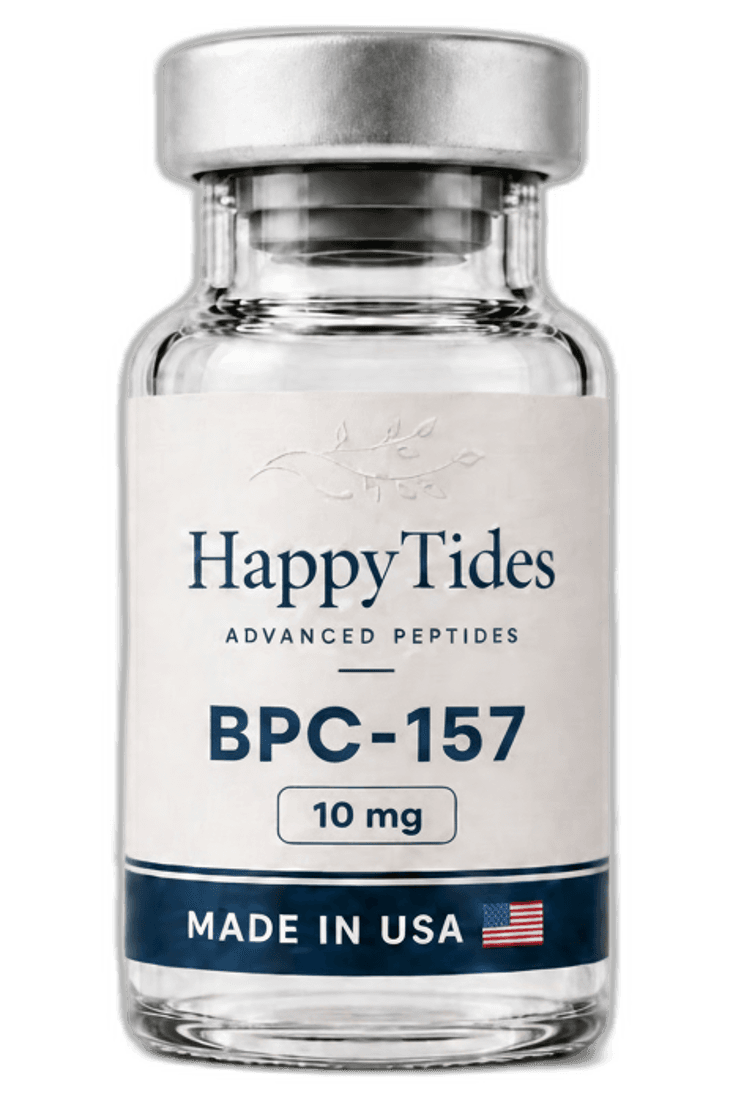
BPC-157, the synthetic 15-amino-acid pentadecapeptide GEPPPGKPADDAGLV, presents an unusual mechanistic profile for in-vitro investigators: across cell-based and isolated-tissue models it behaves not as a ligand for a single cloned receptor but as a modulator of endothelial and fibroblast signaling networks. This distinction matters at the bench, because experimental design cannot assume a defined binding pocket or a competitive antagonist. Instead, the documented activity is read out through downstream phosphorylation states, transcript and protein abundance, and cytoskeletal reorganization. The reference data converge on three interlocking signaling threads: VEGFR2-centered angiogenic signaling, a VEGF-independent nitric-oxide route through Src and Caveolin-1, and focal-adhesion kinase activity in tendon fibroblasts. The sections below expand each thread into its component molecular interactions as captured in the provided source set, keeping every claim within the in-vitro and ex-vivo receptor-signaling frame and avoiding any extrapolation to organismal outcomes.
The detail
A closer look
01
The VEGFR2-Akt-eNOS axis and endocytic dependence
In vascular endothelial cell models, BPC-157 up-regulates VEGFR2 (KDR) at both the mRNA and protein level while notably not raising VEGF-A ligand concentration. This separates receptor abundance from ligand supply, an uncommon arrangement that the Hsieh et al. 2017 work (J Mol Med, PMID 27847966) frames around receptor up-regulation rather than classical ligand-driven signaling. The peptide also promotes VEGFR2 internalization, and the resulting signal feeds a time-dependent VEGFR2-Akt-eNOS cascade. The endocytic step is mechanistically load-bearing: the activation is abolished by dynasore, a dynamin-dependent endocytosis inhibitor, indicating that receptor internalization is required rather than incidental. For bench design, dynasore sensitivity offers a discriminating control to confirm the pathway is engaged through internalization rather than surface signaling alone.
02
A VEGF-independent nitric-oxide route via Src and Caveolin-1
Parallel to the VEGFR2 thread, the provided data describe a second, VEGF-independent route to nitric-oxide output. Here BPC-157 engages Src kinase-mediated phosphorylation within the Caveolin-1/eNOS complex. Caveolin-1 normally holds eNOS in an inhibited state; Src-driven phosphorylation within this complex releases eNOS, increasing nitric oxide production and modulating vasomotor tone in a nitric-oxide-dependent manner in ex-vivo tissue, as reported by Hsieh et al. 2020 (Scientific Reports, PMID 33051481). Because this branch does not require VEGF, it can be probed independently of the VEGFR2 transcriptional response. The Sikiric et al. 2014 review (Current Pharmaceutical Design, PMID 23755725) frames the peptide's broader profile specifically around interaction with the nitric-oxide system, consistent with both eNOS-centered observations.
03
Focal-adhesion signaling in tendon fibroblasts
The third documented thread sits in tendon fibroblast culture rather than endothelium. Chang et al. 2011 (J Appl Physiol, PMID 21030672) report that BPC-157 increases phosphorylation of focal adhesion kinase (FAK) and paxillin, two core components of the focal-adhesion machinery that couples integrin engagement to actin dynamics. Downstream, the peptide promotes F-actin assembly and enhances cell spreading and migration in outgrowth and migration assays. This is a cytoskeletal-signaling readout distinct from the endothelial nitric-oxide work: the measurable endpoints are phospho-FAK, phospho-paxillin, F-actin organization, and migratory distance, not receptor abundance or NO flux. Reported activity across these systems spans nanomolar-to-micromolar concentrations in vitro, so concentration-response design should bracket that range when probing fibroblast cytoskeletal endpoints.
The fine print: products are sold for laboratory research use only and are not for human or animal consumption. Bodily introduction into humans or animals is strictly prohibited by law. BPC-157 is not a drug and is not intended to diagnose, treat, cure, or prevent any disease. These statements have not been evaluated by the FDA.