
TB-500 Specs: Sequence, MW & CAS
Part of the full TB-500 guide - a synthetic β-thymosin-derived heptapeptide reference compound, identity-verified with a COA on every vial.
In brief
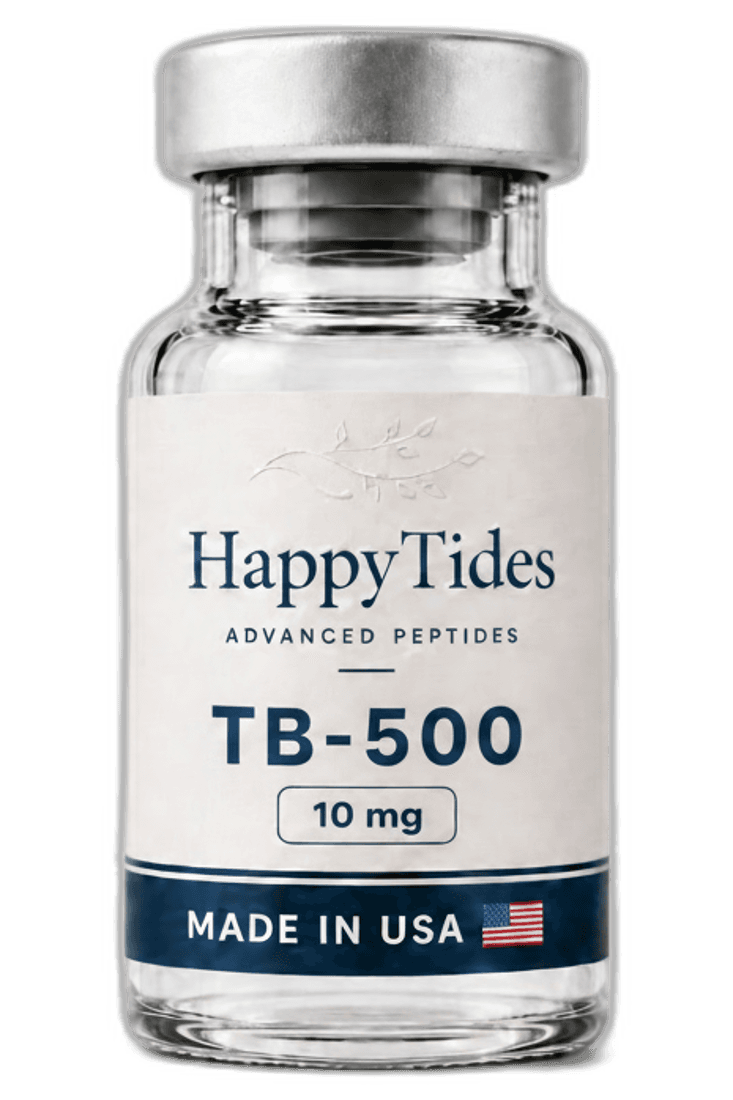
TB-500's molecular specification is unusually informative because its identity directly encodes its mechanism. The entry defines it as a synthetic N-acetylated heptapeptide, sequence Ac-Leu-Lys-Lys-Thr-Glu-Thr-Gln-OH (Ac-LKKTETQ), corresponding to residues 17-23 of thymosin beta-4 and containing the conserved LKKTET actin-binding motif. Its molecular weight is ~889.0 g/mol for the free base (~949.1 g/mol as the acetate salt), with molecular formula C38H68N10O14 for the free base and C40H72N10O16 for the acetate salt (PubChem CID 155977548). The CAS Registry Number is 885340-08-9. This section explains what each of these specifications means and how the sequence-to-structure relationship determines function. Reading the spec card as a chemist would, the residue composition, the terminal acetyl cap, the salt-form mass difference, and the registry identifiers together pin down exactly which molecule is in the vial and why it behaves as an actin-binding fragment in laboratory assays.
To the molecule
Molecular specifications
Ac-Leu-Lys-Lys-Thr-Glu-Thr-Gln-OH (Ac-LKKTETQ); corresponds to residues 17-23 of thymosin β-4, containing the conserved LKKTET actin-binding motifThe detail
A closer look
01
Sequence and the LKKTET motif
The sequence Ac-LKKTETQ is the structural heart of the specification. The seven residues are leucine, lysine, lysine, threonine, glutamate, threonine, glutamine, with the central LKKTET stretch forming the conserved actin-binding motif that defines WH2-domain peptides. The two adjacent lysines are functionally critical: mutational mapping (Van Troys et al., EMBO J 1996, PMID 8617195) localizes the principal actin contacts to electrostatic interactions involving these LKKTET lysines, such as Lys18. Because TB-500 corresponds precisely to residues 17-23 of thymosin beta-4, it isolates this motif from the larger parent peptide, making the sequence itself a statement of structure-function: the residues present are exactly those required for monomer recognition, which is why the fragment is studied as the minimal actin-binding determinant.
02
The N-acetyl cap and the C-terminus
The leading Ac- denotes N-terminal acetylation, a deliberate cap on the alpha-amino group of the N-terminal leucine, while the -OH terminus indicates a free carboxylic acid C-terminus rather than an amide. These terminal designations are part of the precise chemical definition: they distinguish this exact heptapeptide from unmodified or amidated variants of the same residue string. The acetyl group is integral to the molecule's identity as recorded in the entry, which describes TB-500 explicitly as an N-acetylated fragment. For a researcher, the terminal chemistry confirms that the material is the defined Ac-LKKTETQ species, ensuring assay results map to the correct molecular entity rather than a sequence-identical but terminally different peptide.
03
Mass, formula, salt form, and registry identifiers
The free base molecular formula C38H68N10O14 corresponds to ~889.0 g/mol, computed consistently with the Ac-LKKTETQ residue masses. The acetate salt form, C40H72N10O16 at ~949.1 g/mol, adds an acetate counterion and is the form catalogued under PubChem CID 155977548; the ~60 g/mol difference is exactly why salt form must be specified for accurate molar calculations. The CAS Registry Number 885340-08-9 is the unambiguous chemical identifier used across ChemicalBook and supplier records to confirm the substance's identity. Together, the formula, dual mass values, and CAS number let a laboratory verify that the received material matches the intended molecule and apply the correct molecular weight when converting between mass and molar concentration for actin-binding assays.
The fine print: products are sold for laboratory research use only and are not for human or animal consumption. Bodily introduction into humans or animals is strictly prohibited by law. TB-500 is not a drug and is not intended to diagnose, treat, cure, or prevent any disease. These statements have not been evaluated by the FDA.