
Retatrutide Specs: Sequence, MW & CAS
Part of the full Retatrutide guide - a synthetic incretin-class peptide; unimolecular triple agonist of the gip receptor reference compound, identity-verified with a COA on every vial.
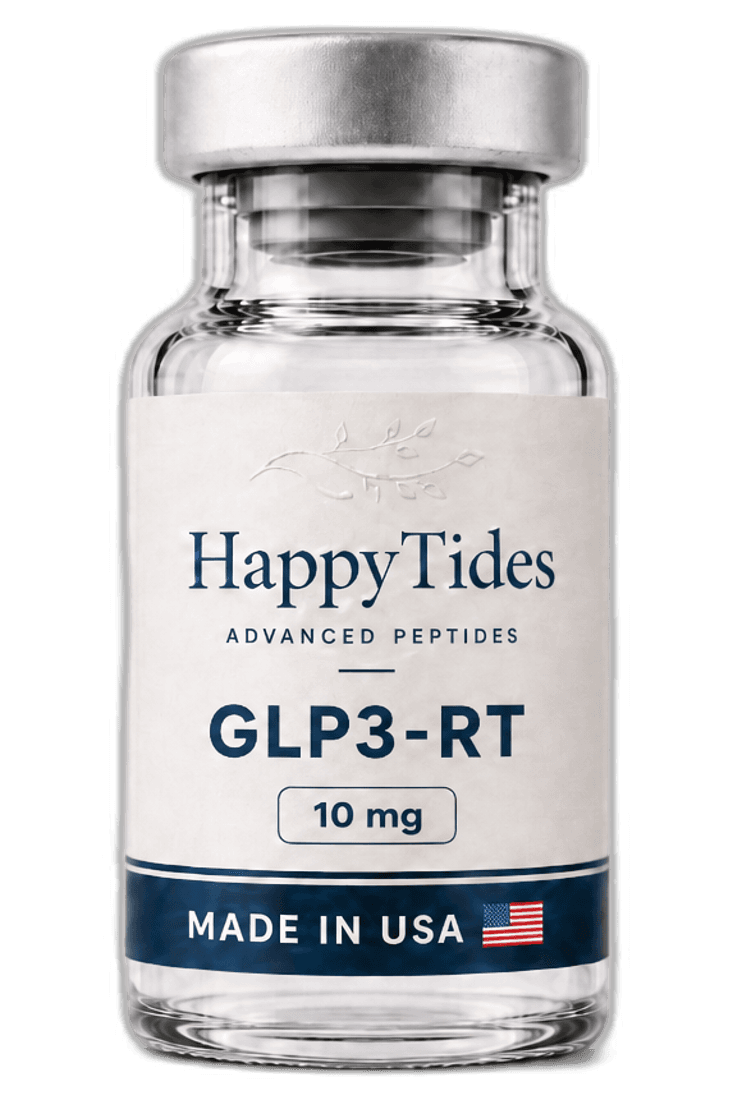
In brief
The molecular specification for retatrutide ties a precise chemical identity to its receptor behavior. It is catalogued with the molecular formula C221H342N46O68, an average molecular weight of 4731.33 g/mol (free base), and CAS Registry Number 2381089-83-2. Structurally it is a 39-residue synthetic peptide built on a GIP-based backbone that incorporates non-coded residues and C-terminal amidation, and it carries the Eli Lilly development code LY3437943 (PubChem CID 171390338). Each of these specification fields means something concrete for a researcher verifying material or reasoning about structure-function. The formula and weight describe the intact lipidated, amidated construct; the CAS number provides an unambiguous registry handle for the free base; and the annotated sequence encodes exactly where the activity-shaping modifications sit. The sections below explain how these specification values map onto the molecule's behavior as a class B1 triple agonist.
To the molecule
Molecular specifications
39-residue synthetic peptide built on a GIP-based backbone with non-coded residues and C-terminal amidation. Reported representation: Tyr-Aib-Gln-Gly-Thr-Phe-Thr-Ser-Asp-Tyr-Ser-Ile-(alpha-Me-Leu)-Leu-Asp-Lys-Lys(gamma-Glu-AEEA-AEEA-C20 diacid)-Ala-Gln-Aib-Ala-Phe-Ile-Glu-Tyr-Leu-Leu-Glu-Gly-Gly-Pro-Ser-Ser-Gly-Ala-Pro-Pro-Pro-Ser-NH2. Key modifications: Aib at position 2 and position 20, alpha-methyl-L-leucine at position 13, and fatty-diacid (C20) acylation via a gamma-Glu/AEEA linker on the Lys at position 17. (Position numbering per the cryo-EM structural paper; one-letter backbone approx. YXQGTFTSDYSIXLDKKAQXAFIEYLLEGGPSSGAPPPS-NH2 with X = non-coded residues.)The detail
A closer look
01
Reading the formula, weight, and CAS number
The molecular formula C221H342N46O68 accounts for every atom of the intact construct, including the C20 fatty-diacid acylation and the C-terminal amide, which is why the average mass, 4731.33 g/mol for the free base, sits well above that of an unmodified peptide of similar length. That mass value is the number used to convert a milligram-per-milliliter laboratory stock into a molar concentration. CAS Registry Number 2381089-83-2 is the unique identifier researchers use to confirm they are referencing the correct entity across supplier datasheets and chemical databases; the entry attributes it to ChemicalBook, BOC Sciences, and MedChemExpress records. Together, formula, weight, and CAS number form the verification triad for confirming material identity before any in-vitro work, independent of the biological characterization.
02
Sequence architecture and structure-function
The 39-residue sequence is built on a GIP-based backbone and is reported with a defined modification map: Aib at positions 2 and 20, alpha-methyl-L-leucine at position 13, a C-terminal amide, and a C20 fatty-diacid acylation attached through a gamma-Glu/AEEA/AEEA linker on the lysine at position 17. Position numbering follows the cryo-EM structural paper, and an approximate one-letter backbone (YXQGTFTSDYSIXLDKKAQXAFIEYLLEGGPSSGAPPPS-NH2, with X denoting non-coded residues) is provided. Functionally, the N-terminal region drives the conserved orthosteric, active-state interaction shared by all three receptors, while mid-region residues are discriminated by receptor-specific extracellular-loop and TM1 contacts. The non-coded residues stabilize the helix and resist proteolysis, and the Lys17 lipidation supports albumin binding, so the sequence annotation directly explains the molecule's durable, balanced tri-receptor signaling.
The fine print: products are sold for laboratory research use only and are not for human or animal consumption. Bodily introduction into humans or animals is strictly prohibited by law. Retatrutide is not a drug and is not intended to diagnose, treat, cure, or prevent any disease. These statements have not been evaluated by the FDA.