
Retatrutide Research & Studies
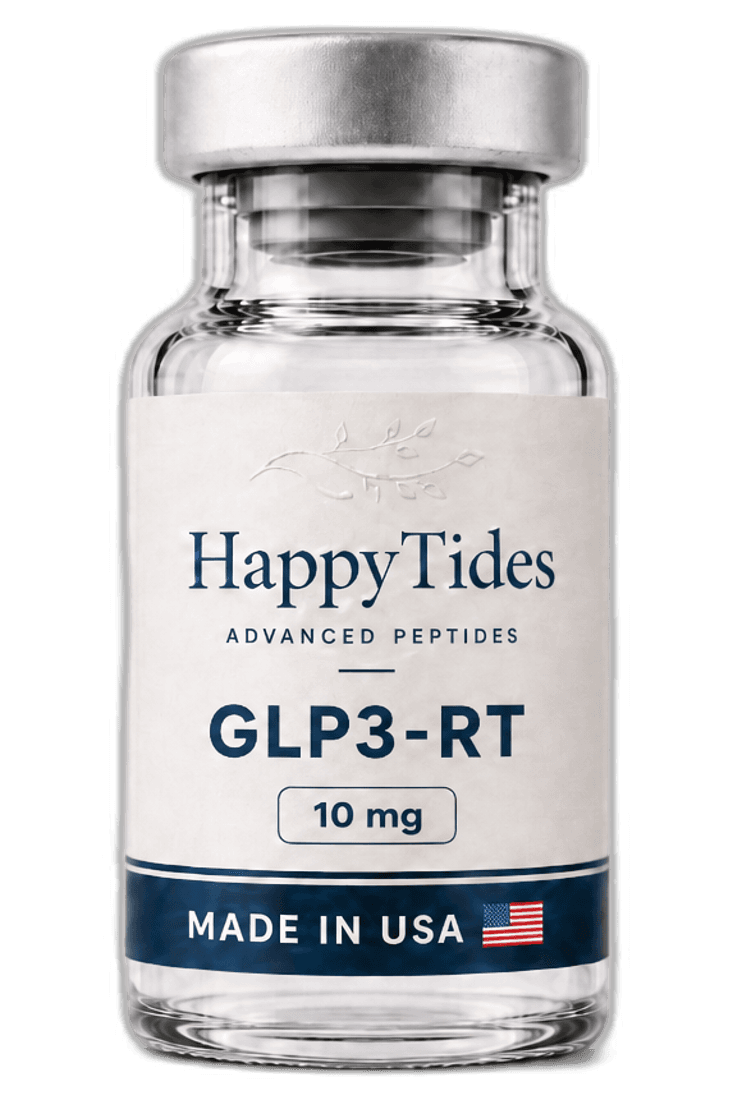
Part of the full Retatrutide guide - a synthetic incretin-class peptide; unimolecular triple agonist of the gip receptor reference compound, identity-verified with a COA on every vial.
In brief
Research interest in retatrutide as documented in the provided sources is anchored in receptor pharmacology and structural biology rather than any single application. The molecule, originally identified by Eli Lilly and Company under the development code LY3437943, serves as a model unimolecular triple agonist for understanding how one peptide can coordinate signaling across the GIP, GLP-1, and glucagon receptors. The three citations attached to this entry span the discovery and characterization of the compound (Coskun et al., Cell Metabolism 2022), the high-resolution structural mechanism of its tri-receptor activation (Li et al., Cell Discovery 2024), and an early-phase clinical pharmacology characterization (Urva et al., The Lancet 2022). Together they frame the research questions that recur in the entry's listed research areas: comparative cAMP/Gs signaling across the three receptors, the active-state conformational mechanism resolved by cryo-EM, receptor selectivity and bias profiling of multi-agonists, and structure-activity relationships of the molecule's non-coded residues and lipidation.
The detail
A closer look
01
Discovery and comparative signaling characterization
The Coskun et al. 2022 paper in Cell Metabolism is cited as the discovery-to-proof-of-concept account of LY3437943, establishing retatrutide as a triple agonist of GIPR, GLP-1R, and GCGR, all Gs-coupled class B1 GPCRs. This is the source attributed to the molecule's receptor-target identity and to its in-vitro relative-potency profile: greater GIPR activity with comparatively balanced GLP-1R and GCGR cAMP signaling. Within the entry's research-area framing, this work underpins in-vitro GPCR pharmacology, the comparison of cAMP/Gs signaling potency and efficacy across the three receptors, and the broader study of receptor selectivity and bias in unimolecular multi-agonist peptides. The PubChem CID 171390338 referenced alongside it ties the characterized molecule to its catalogued chemical identity.
02
Structural mechanism by cryo-EM
The Li et al. 2024 paper in Cell Discovery, titled 'Structural insights into the triple agonism at GLP-1R, GIPR and GCGR manifested by retatrutide,' supplies the structural-biology backbone of the entry. It is the source for the cryo-EM determination of peptide-receptor-Gs ternary complexes, for the conserved N-terminal orthosteric interaction that drives the active-state conformation, and for the receptor-specific ECL1/ECL2 and TM1-tip contacts that explain simultaneous tri-receptor activation. It is also the cited basis for the precise structural modifications, Aib2 and Aib20, alpha-methyl-Leu13, C-terminal amide, and C20 fatty-diacid acylation via a gamma-Glu/AEEA linker on Lys17, and for the Gs-coupled adenylyl-cyclase/cAMP activation readout in recombinant cells. This work directly serves the entry's structural-biology and structure-activity research areas.
03
Early clinical pharmacology context
The Urva et al. 2022 paper in The Lancet is cited as a phase 1b, multicentre, double-blind, placebo-controlled, randomised, multiple-ascending-dose characterization of LY3437943 in people with type 2 diabetes. Within this reference page it is presented strictly as part of the molecule's documented research record, identifying retatrutide as a novel triple GIP, GLP-1, and glucagon receptor agonist. For a research-use-only reference, the relevant takeaway is bibliographic: it places the triple-agonist mechanism within an early human pharmacology study by the originating group. No dosing, outcome, or application claims are drawn from it here; it functions to round out the citation set alongside the discovery and structural papers that define the molecule's receptor biology.
The fine print: products are sold for laboratory research use only and are not for human or animal consumption. Bodily introduction into humans or animals is strictly prohibited by law. Retatrutide is not a drug and is not intended to diagnose, treat, cure, or prevent any disease. These statements have not been evaluated by the FDA.