
Retatrutide Mechanism of Action
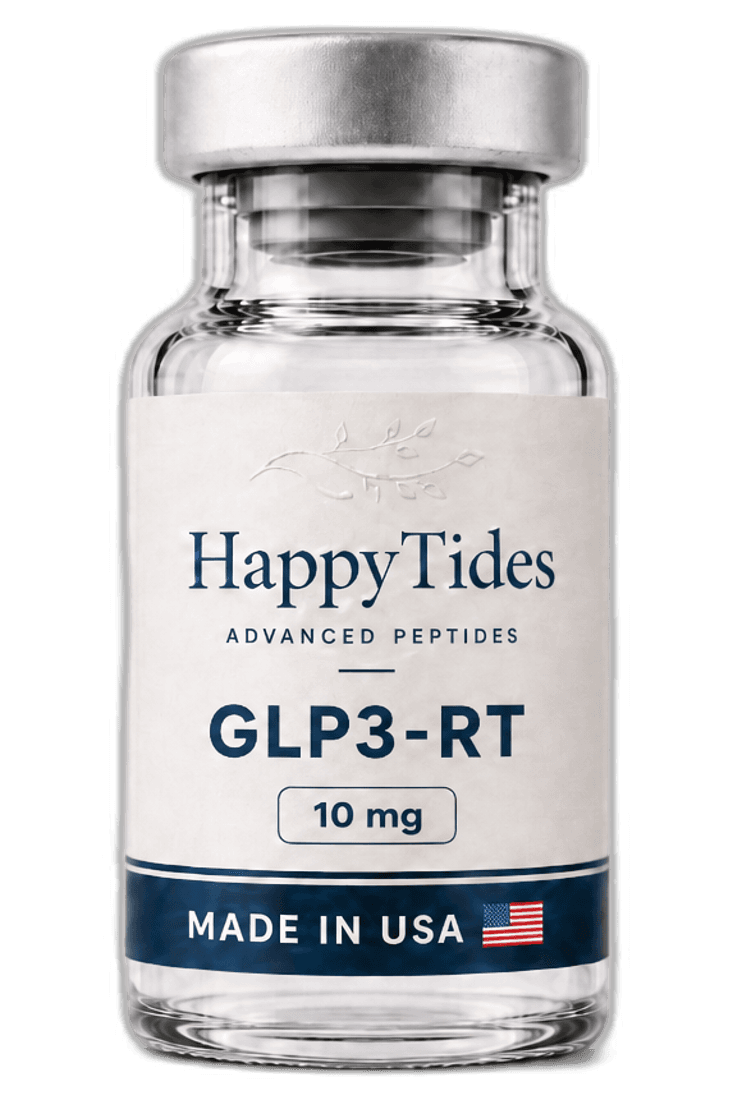
Part of the full Retatrutide guide - a synthetic incretin-class peptide; unimolecular triple agonist of the gip receptor reference compound, identity-verified with a COA on every vial.
In brief
Retatrutide is studied as a single 39-residue synthetic peptide that engages three distinct class B1 G-protein-coupled receptors at once: the GIP receptor (GIPR), the GLP-1 receptor (GLP-1R), and the glucagon receptor (GCGR). What makes it a useful tool molecule for receptor-signaling work is that one chemical entity, rather than a cocktail, drives all three pathways. In recombinant cell systems each of the three receptors couples to the stimulatory G protein Gs, so the shared downstream consequence of binding is adenylyl-cyclase activation and a rise in intracellular cyclic AMP (cAMP). That cAMP accumulation is the standard quantitative readout investigators use to compare potency and efficacy across the three receptors. The sections below unpack the orthosteric N-terminal interaction common to all three receptors, the receptor-specific contacts that permit simultaneous tri-receptor activation, and the role of the molecule's non-coded residues and lipidation in shaping that signaling behavior.
The detail
A closer look
01
Conserved orthosteric engagement and the active-state switch
Cryo-electron microscopy of retatrutide bound to each receptor-Gs complex resolves a conserved N-terminal interaction in which the peptide's amino terminus inserts into the orthosteric transmembrane pocket of the receptor. In the class B1 GPCR framework this insertion is what triggers the active-state conformation, repositioning the transmembrane helices so the receptor can engage and activate Gs on the intracellular face. Because the same N-terminal recognition element drives all three receptors, retatrutide can act as a balanced agonist rather than a partial ligand at any one target. The functional consequence captured in cell-based assays is adenylyl-cyclase turnover producing cAMP, the second messenger that reports active-state coupling. This shared mechanism explains why a single peptide backbone is sufficient to recruit Gs at GIPR, GLP-1R, and GCGR despite their divergent sequences.
02
Receptor-specific contacts enabling tri-agonism
Although the N-terminus is conserved, the structural work shows that sequence variations in the mid-region of the peptide are read out differently by each receptor. According to the cryo-EM analysis, receptor-specific extracellular-loop contacts (ECL1 and ECL2) together with TM1-tip interactions discriminate among GIPR, GLP-1R, and GCGR. This division of labor, conserved N-terminus for activation plus a variable mid-region for receptor discrimination, rationalizes how one molecule simultaneously satisfies three orthosteric pockets. Functionally, the engagement is not uniform: in cell-based cAMP assays retatrutide shows relatively greater GIPR activity, with comparatively balanced GLP-1R and GCGR engagement. This makes the molecule a reference compound for selectivity and bias-profiling studies of unimolecular multi-agonists, where the question is how a single backbone tunes relative potency across related class B1 receptors.
03
How sequence chemistry shapes the signal
The peptide's pharmacological behavior in vitro is inseparable from its non-coded chemistry. Aib (2-aminoisobutyric acid) substitutions at positions 2 and 20 and alpha-methyl-L-leucine at position 13 confer protease resistance and helix stabilization, helping the backbone hold the active conformation that the receptors recognize. A C20 fatty-diacid acylation, attached through a gamma-Glu/AEEA linker on the lysine at position 17, promotes albumin binding, which in experimental systems extends the molecule's residence. C-terminal amidation completes the construct. These modifications do not change the fundamental Gs-cAMP readout but they govern how durably and reproducibly the peptide can occupy its receptors, which is why structure-activity relationship studies of the non-coded residues and the lipidation moiety are a recognized research focus for this molecule.
The fine print: products are sold for laboratory research use only and are not for human or animal consumption. Bodily introduction into humans or animals is strictly prohibited by law. Retatrutide is not a drug and is not intended to diagnose, treat, cure, or prevent any disease. These statements have not been evaluated by the FDA.