
Retatrutide Reconstitution Guide
Part of the full Retatrutide guide - a synthetic incretin-class peptide; unimolecular triple agonist of the gip receptor reference compound, identity-verified with a COA on every vial.
In brief
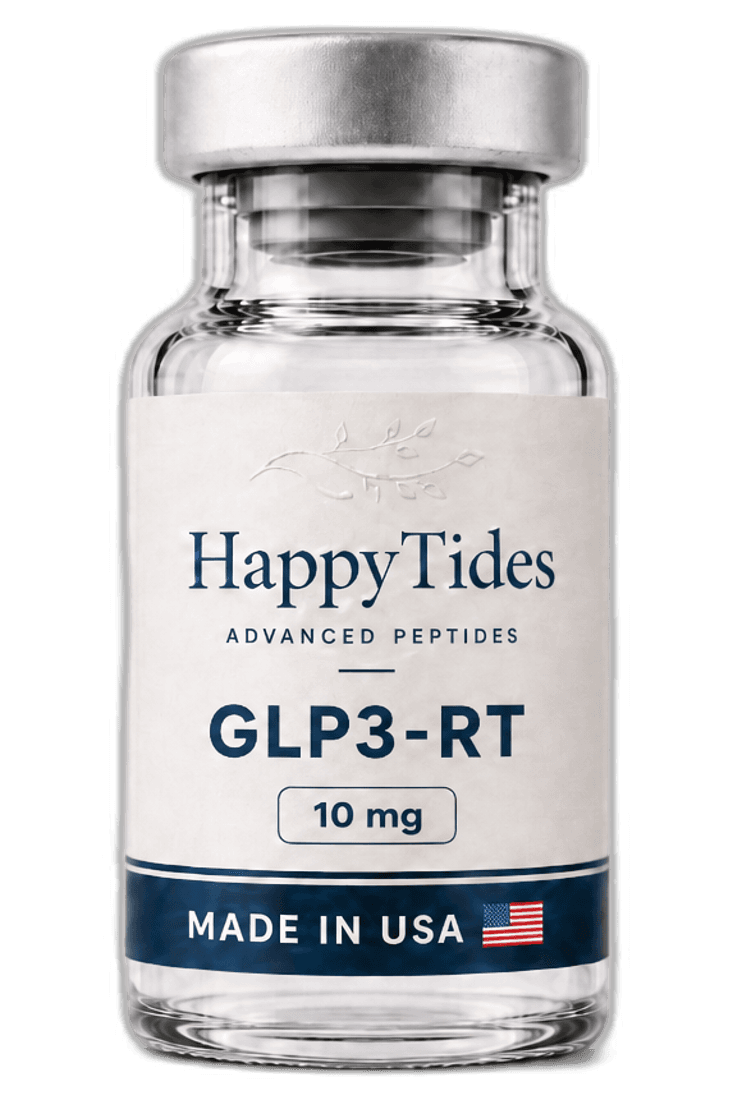
This section describes laboratory reconstitution of retatrutide for in-vitro research handling only; it is not a human dosing protocol. Retatrutide is typically supplied as a lyophilized (freeze-dried) powder, and the standard laboratory practice for class B1 GPCR peptide ligands is to reconstitute the solid into a defined-concentration stock with a sterile aqueous diluent before preparing working dilutions for cell-based cAMP assays. Bacteriostatic water (water for injection containing a low percentage of benzyl alcohol) is a commonly used reconstitution diluent because the bacteriostatic agent suppresses microbial growth across repeated vial entries, which matters when a single stock supports multiple assay sessions. The governing idea is simple mass-balance: dividing the labeled peptide mass in the vial by the volume of diluent added yields the stock concentration. Because retatrutide carries a lipidated, albumin-binding C20 fatty-diacid moiety, gentle handling during reconstitution helps avoid foaming and adsorptive losses on the vessel walls.
The detail
A closer look
01
Concentration math and stability handling
Stock concentration follows directly from the peptide mass and diluent volume. For example, reconstituting a vial labeled as containing 5 mg of retatrutide in 2 mL of bacteriostatic water yields 2.5 mg/mL; using 1 mL yields 5 mg/mL. To express a molar stock, divide the mass concentration by the average molecular weight of 4731.33 g/mol, so 5 mg in 2 mL corresponds to roughly 0.53 mM. Reconstitution volume is therefore chosen to land the stock in a range convenient for serial dilution into assay buffer. For stability, the reconstituted peptide is generally kept refrigerated for near-term work and stored frozen for longer-term retention, with aliquoting used to avoid repeated freeze-thaw cycles that can degrade peptides. The lyophilized solid is the most stable form, so material is reconstituted only as needed and protected from prolonged warmth and light during handling.
Step by step
How Retatrutide is reconstituted
A bench reference for handling and preparation in an in-vitro research setting. Not a personal dosing protocol.
- 1
Equilibrate the sealed lyophilized retatrutide vial to room temperature before opening to limit condensation on the powder.
- 2
Calculate the diluent volume from the labeled peptide mass and the target stock concentration (mass concentration = peptide mass / diluent volume; molar concentration = mass concentration / 4731.33 g/mol).
- 3
Draw the calculated volume of sterile bacteriostatic water into a syringe or pipette.
- 4
Add the diluent slowly down the inner wall of the vial rather than directly onto the powder to minimize foaming of the lipidated peptide.
- 5
Do not shake; swirl gently or let the vial stand until the powder is fully dissolved into a clear solution.
- 6
Record the resulting stock concentration (mg/mL and mM) and the reconstitution date on the vial.
- 7
Aliquot the stock into single-use volumes to avoid repeated freeze-thaw cycles.
- 8
Store working stock refrigerated for near-term in-vitro use and freeze remaining aliquots for longer-term retention, keeping the original lyophilized form as the most stable reference.
The fine print: products are sold for laboratory research use only and are not for human or animal consumption. Bodily introduction into humans or animals is strictly prohibited by law. Retatrutide is not a drug and is not intended to diagnose, treat, cure, or prevent any disease. These statements have not been evaluated by the FDA.