
Retatrutide - Frequently Asked Questions
Part of the full Retatrutide guide - a synthetic incretin-class peptide; unimolecular triple agonist of the gip receptor reference compound, identity-verified with a COA on every vial.
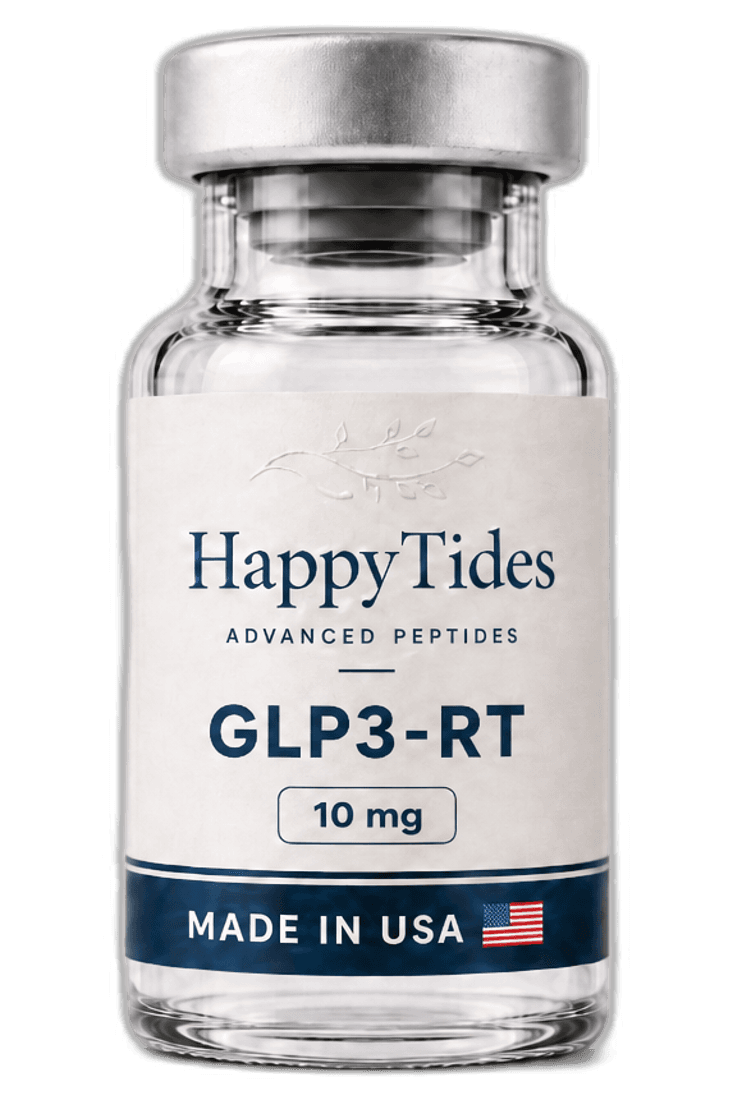
Straight answers
Retatrutide, answered
What class of peptide is retatrutide?
It is a synthetic incretin-class peptide and a unimolecular triple agonist of the GIP receptor (GIPR), GLP-1 receptor (GLP-1R), and glucagon receptor (GCGR), which are all Gs-coupled class B1 G-protein-coupled receptors. It is a long-acting lipidated (fatty-diacid-acylated) peptide.
Which receptors does it activate, and what is the in-vitro readout?
It activates GIPR, GLP-1R, and GCGR. In recombinant cell systems each receptor couples to Gs, so agonist binding drives adenylyl-cyclase activation and intracellular cAMP accumulation. That cAMP accumulation is the standard in-vitro readout used to quantify potency.
Is the activity balanced across the three receptors?
In cell-based cAMP assays retatrutide shows relatively greater GIPR activity, with comparatively balanced GLP-1R and GCGR engagement, per the Coskun et al. 2022 and Li et al. 2024 sources.
What are its molecular formula, weight, and CAS number?
The molecular formula is C221H342N46O68, the average molecular weight is 4731.33 g/mol (free base), and the CAS Registry Number is 2381089-83-2.
What is the sequence and which modifications matter?
It is a 39-residue synthetic peptide on a GIP-based backbone with C-terminal amidation. Key modifications are Aib at positions 2 and 20, alpha-methyl-L-leucine at position 13, and a C20 fatty-diacid acylation via a gamma-Glu/AEEA linker on the lysine at position 17.
Why does retatrutide include non-coded residues and a fatty-diacid chain?
The non-coded residues (Aib, alpha-methyl-leucine) confer protease resistance and helix stabilization, while the fatty-diacid acylation promotes albumin binding for extended residence in vitro. These are the structural reasons it is described as long-acting.
How can it engage three different receptors at once?
Cryo-EM shows a conserved N-terminal interaction inserting into the orthosteric transmembrane pocket to trigger the active state, while mid-region sequence variations are read out by receptor-specific extracellular-loop (ECL1/ECL2) and TM1-tip contacts, which rationalizes simultaneous tri-receptor activation.
Who developed it and what is its development code?
It was developed by Eli Lilly and Company under the code LY3437943 (PubChem CID 171390338).
What do the cited references investigate?
Coskun et al. 2022 (Cell Metabolism) covers discovery and comparative receptor signaling; Li et al. 2024 (Cell Discovery) reports the cryo-EM structural mechanism of triple agonism; and Urva et al. 2022 (The Lancet) is an early-phase pharmacology characterization of the triple agonist.
Is this material intended for any human use?
No. This is a research-use-only reference. All framing here is in-vitro, receptor-signaling, and laboratory-research oriented, and no human dosing or application guidance is provided.
How should it be handled and reconstituted in the lab?
For in-vitro work the lyophilized powder is reconstituted with a sterile aqueous diluent such as bacteriostatic water; stock concentration equals peptide mass divided by diluent volume, and molar concentration uses the 4731.33 g/mol average mass. The solid is the most stable form, so it is reconstituted as needed, aliquoted to avoid freeze-thaw cycles, and kept cold.
The fine print: products are sold for laboratory research use only and are not for human or animal consumption. Bodily introduction into humans or animals is strictly prohibited by law. Retatrutide is not a drug and is not intended to diagnose, treat, cure, or prevent any disease. These statements have not been evaluated by the FDA.