
CJC-1295 without DAC Research & Studies
Part of the full CJC-1295 without DAC guide - a synthetic growth hormone-releasing hormone reference compound, identity-verified with a COA on every vial.
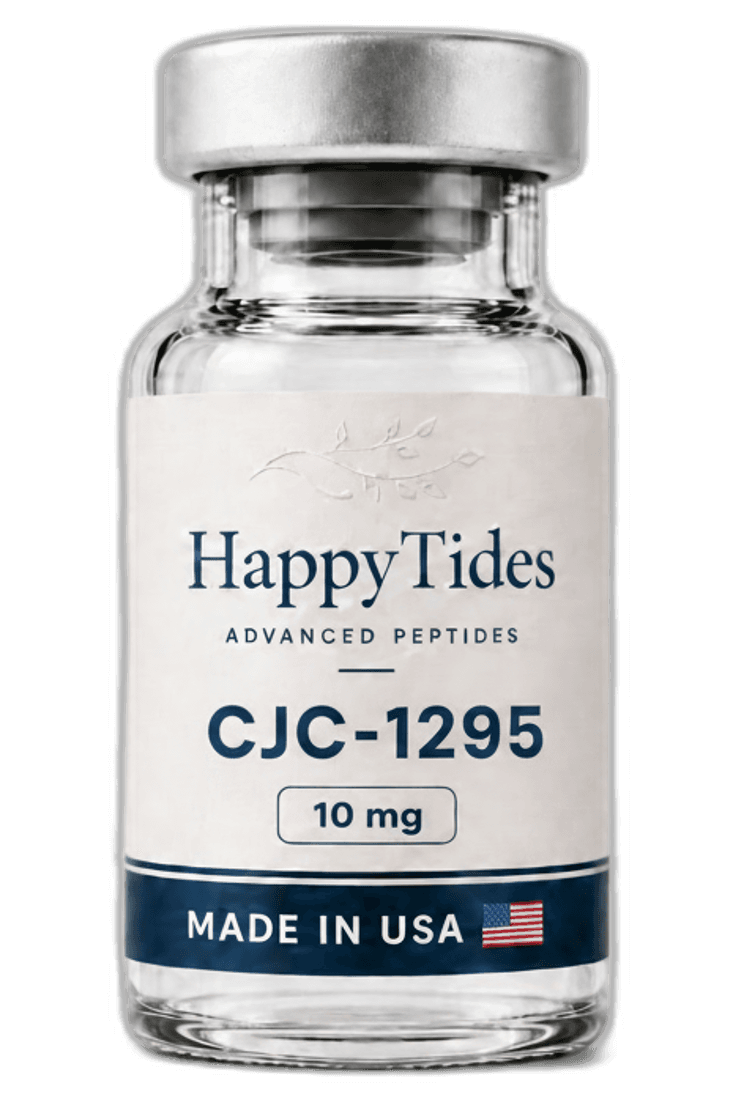
In brief
The research context attached to CJC-1295 without DAC is narrow and well-bounded: four cited sources and six named research areas, all oriented toward receptor pharmacology, signal transduction, structure-activity relationships and metabolic-stability assays of GHRH(1-29) analogs. Rather than therapeutic outcomes, the cited literature investigates how the GHRH-receptor agonist class behaves at the molecular and cellular level, what an albumin-binding extension does to a GRF analog, how a D-Ala2 substitution changes peptide stability, and how GHRH signaling produces cAMP in cells expressing the relevant receptors. This spoke maps each provided citation and research area to the specific in-vitro or preclinical question it addresses, attributing claims only to the sources in the entry and keeping the framing at the level of receptor-signaling and laboratory models, never personal use or clinical endpoints.
The detail
A closer look
01
Jette et al. 2005 - albumin bioconjugates and the GRF receptor
The Jette et al. (2005) Endocrinology paper is the source that identifies CJC-1295 as a long-lasting GRF analog. Its stated subject is hGRF(1-29)-albumin bioconjugates and their activation of the GRF receptor on the anterior pituitary in rats. This is the preclinical, receptor-level context that defines the DAC concept: bioconjugates that bind albumin to extend action. For the no-DAC entry, this citation is the anchor for the comparison point, because the no-DAC form is precisely the variant that lacks the albumin-binding extension central to the Jette work. It situates the molecule within an animal/anterior-pituitary model investigating GRF-receptor activation and the longevity conferred by albumin conjugation.
02
Soule et al. 1994 and Cunha & Mayo 2002 - stability and cAMP
Soule, King & Millar (1994) in the Journal of Clinical Endocrinology & Metabolism is cited for the molecular-stability claim: incorporating D-Ala2 into GHRH-(1-29)-NH2 increases half-life and decreases metabolic clearance. This is the source attributed to the entry's DPP-IV-resistance and metabolic-stability research area. Cunha & Mayo (2002), also in Endocrinology, examines how ghrelin and GH secretagogues potentiate GHRH-induced cyclic AMP production in cells expressing transfected GHRH and GH-secretagogue receptors. That paper is the in-vitro, transfected-cell anchor for the Gs/adenylyl-cyclase/cAMP signal-transduction research area, demonstrating the cAMP readout central to the mechanism in a controlled cell-expression system.
03
Halmos et al. 2025 - GHRH-R signaling review
The Halmos, Szabo, Dobos, Juhasz & Schally (2025) review in Reviews in Endocrine and Metabolic Disorders addresses the GHRH receptor and its signaling broadly. In the entry it is cited to confirm the receptor target: GHRH-R, a class B Gs-coupled GPCR on somatotrophs, explicitly not the ghrelin/GHS-R receptor. As a review, it supplies the receptor-biology framing for the binding and agonist-pharmacology research area and for the structure-activity-relationship work on GHRH(1-29) substitution analogs. Together with the three primary papers, it completes a citation set focused on receptor identity, signaling and analog design rather than any clinical or dosing outcome.
04
The six named research areas as a map
The entry enumerates six in-vitro and preclinical research areas that frame the whole molecule: GHRH-receptor binding and agonist pharmacology in vitro; Gs/adenylyl-cyclase/cAMP/PKA signal transduction in somatotroph cell models; structure-activity relationships of GHRH(1-29) substitution analogs; DPP-IV resistance and peptide metabolic-stability assays; comparative receptor-occupancy kinetics of DAC versus no-DAC analogs in animal/cell models; and GH/IGF-1 axis endocrine-signaling research models. Each maps cleanly onto one or more of the four citations, giving a coherent laboratory research program: identify the receptor, characterize its signaling, engineer the sequence, test the stability, and compare occupancy kinetics across analog variants in cell and animal systems.
The fine print: products are sold for laboratory research use only and are not for human or animal consumption. Bodily introduction into humans or animals is strictly prohibited by law. CJC-1295 without DAC is not a drug and is not intended to diagnose, treat, cure, or prevent any disease. These statements have not been evaluated by the FDA.