
CJC-1295 without DAC Mechanism of Action
Part of the full CJC-1295 without DAC guide - a synthetic growth hormone-releasing hormone reference compound, identity-verified with a COA on every vial.
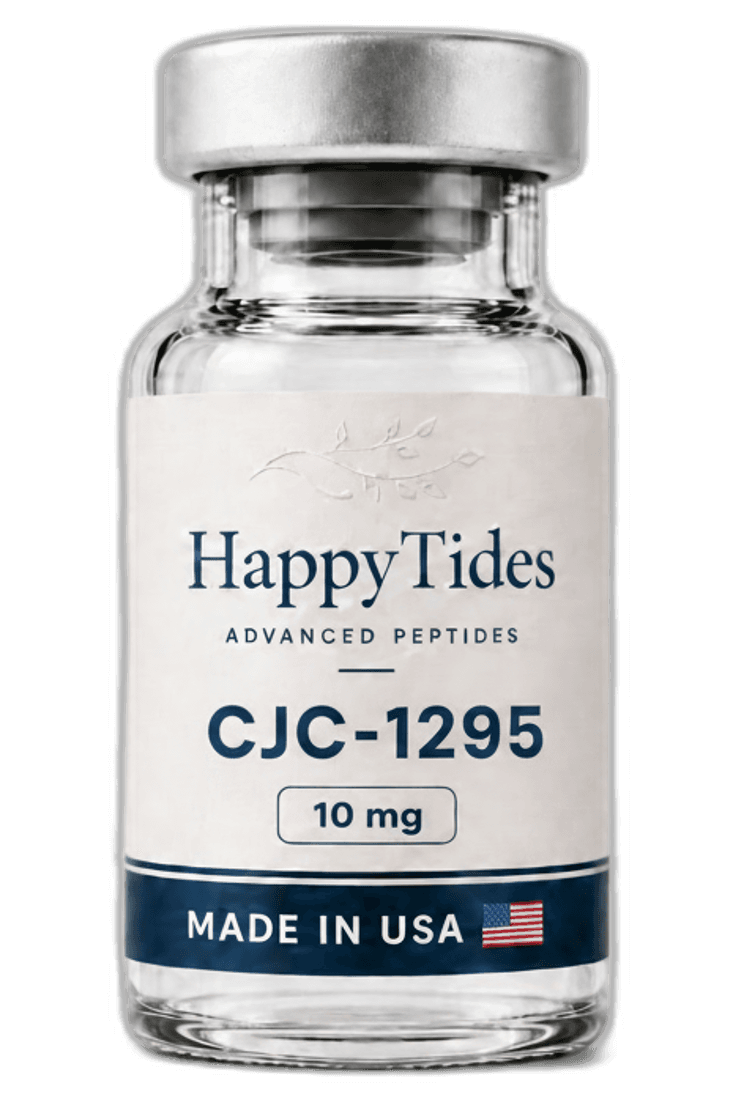
In brief
CJC-1295 without DAC (Mod GRF 1-29) is a tetrasubstituted GHRH(1-29) amide whose mechanism is best understood at the level of a single receptor: the growth hormone-releasing hormone receptor (GHRH-R), a class B G protein-coupled receptor expressed on pituitary somatotroph cells. In receptor-level studies, the peptide behaves as an agonist at this site, distinct from the ghrelin/GHS-R axis. Engagement of GHRH-R couples through the stimulatory G protein Gs to adenylyl cyclase, lifting intracellular cAMP and recruiting protein kinase A, with downstream calcium influx and somatotroph signaling consistent with GH-axis activation in model systems. This spoke unpacks that cascade step by step and situates the four engineered substitutions, D-Ala2, Gln8, Ala15 and Leu27, within the molecular logic of receptor binding and enzymatic resistance, rather than restating the summary headline.
The detail
A closer look
01
Class B GPCR engagement at GHRH-R
The defined target is the GHRH receptor, a class B (secretin-family) Gs-coupled GPCR situated on somatotroph cells of the anterior pituitary. Identifying the receptor as class B matters mechanistically: these receptors recognize peptide ligands through a two-domain mode, where the extracellular region captures the C-terminal portion of the peptide and the helical transmembrane core engages the N-terminus to trigger activation. As a GHRH(1-29) amide analog, Mod GRF 1-29 preserves the 1-29 residue span that constitutes the minimal sequence retaining GHRH-receptor agonist activity. The keyFacts explicitly note the target is GHRH-R, not the ghrelin/GHS-R receptor, which fixes the pharmacology to the GHRH arm of GH-axis regulation in the cited receptor-occupancy and binding studies rather than the secretagogue-receptor arm.
02
Gs / adenylyl cyclase / cAMP / PKA transduction
Once the agonist occupies GHRH-R, the receptor couples through Gs to activate adenylyl cyclase, raising intracellular cAMP. Elevated cAMP engages protein kinase A signaling, and in the model systems described this is associated with downstream calcium influx and somatotroph signaling consistent with GH-axis activation. This Gs/cAMP/PKA cascade is the canonical GHRH transduction pathway and is one of the entry's named research areas for pituitary somatotroph cell models. The Cunha & Mayo (2002) citation specifically concerns GHRH-induced cyclic AMP production in cells expressing transfected GHRH receptors, anchoring the cAMP step of this mechanism to a cited in-vitro source rather than to generalized assumption.
03
Four substitutions and DPP-IV resistance
Relative to native GRF(1-29), four residues are substituted: D-Ala at position 2, Gln8, Ala15 and Leu27. The entry states these sit at metabolically labile or oxidation-prone sites. The D-Ala2 substitution is the load-bearing one for stability: per the Soule, King & Millar (1994) source, incorporating D-Ala2 confers resistance to dipeptidyl peptidase-IV cleavage and lowers the metabolic clearance rate relative to the unmodified peptide in the cited assays. Because DPP-IV cleaves the N-terminal dipeptide of native GHRH, protecting position 2 directly blunts that degradation route, extending the window over which the intact agonist can occupy GHRH-R in experimental models.
04
No-DAC structural distinction and occupancy kinetics
The defining contrast with the DAC variant is structural and kinetic. The no-DAC form lacks the C-terminal Nε-maleimidopropionyl-Lys30 albumin-binding extension that the DAC version carries. Without that maleimidopropionyl handle, the no-DAC peptide does not form covalent serum-albumin bioconjugates, so it cannot tether to circulating albumin the way the Jette et al. (2005) hGRF(1-29)-albumin bioconjugates do. The practical mechanistic consequence noted in the entry is comparatively short receptor-occupancy kinetics in experimental models, versus the long-lasting profile of the albumin-binding DAC form. Comparative receptor-occupancy kinetics of DAC versus no-DAC analogs is itself a listed research area for animal and cell models.
The fine print: products are sold for laboratory research use only and are not for human or animal consumption. Bodily introduction into humans or animals is strictly prohibited by law. CJC-1295 without DAC is not a drug and is not intended to diagnose, treat, cure, or prevent any disease. These statements have not been evaluated by the FDA.