
CJC-1295 without DAC - Frequently Asked Questions
Part of the full CJC-1295 without DAC guide - a synthetic growth hormone-releasing hormone reference compound, identity-verified with a COA on every vial.
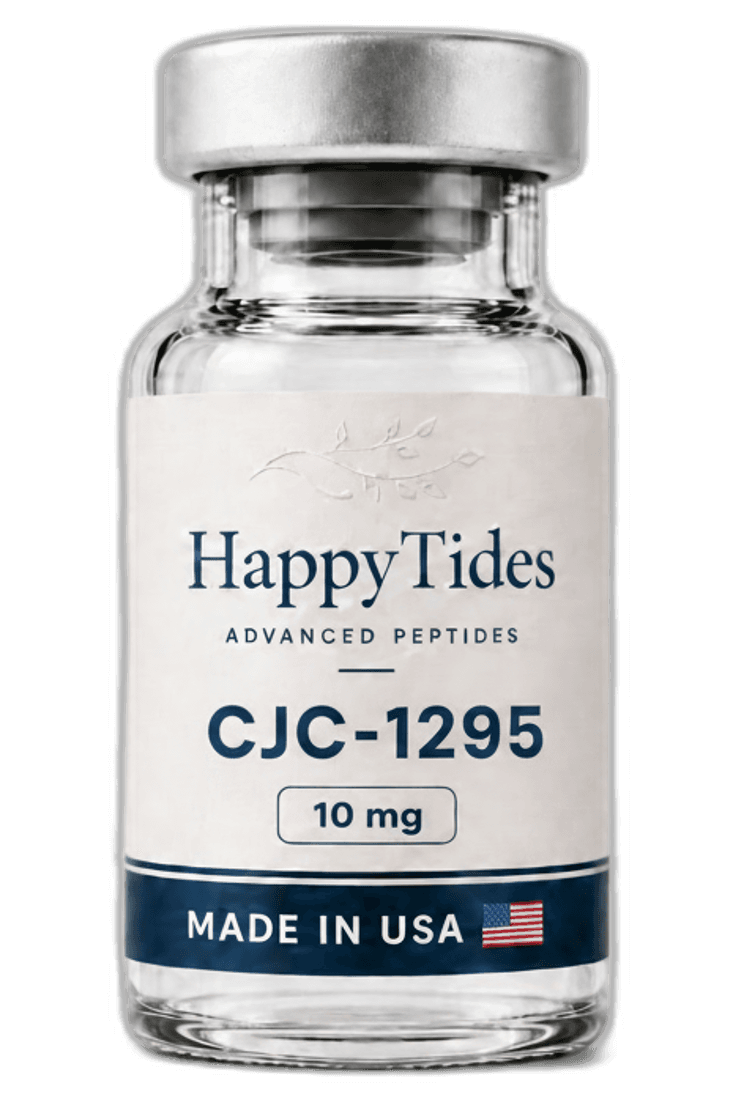
Straight answers
CJC-1295 without DAC, answered
What class of peptide is CJC-1295 without DAC?
It is a synthetic growth hormone-releasing hormone (GHRH/GRF) analog, specifically a tetrasubstituted GHRH(1-29) amide, classified as a growth hormone secretagogue of the GHRH-receptor agonist class. It is also known as Mod GRF 1-29.
What receptor does it target, and is it the same as ghrelin's receptor?
Its target is the GHRH receptor (GHRH-R), a class B Gs-coupled G protein-coupled receptor on pituitary somatotroph cells. Per the entry's keyFacts and the Halmos et al. 2025 review, this is explicitly not the ghrelin/GHS-R receptor; it acts on the GHRH arm of the GH axis.
What is its amino acid sequence?
A 29-residue C-terminal amide: Tyr-D-Ala-Asp-Ala-Ile-Phe-Thr-Gln-Ser-Tyr-Arg-Lys-Val-Leu-Ala-Gln-Leu-Ser-Ala-Arg-Lys-Leu-Leu-Gln-Asp-Ile-Leu-Ser-Arg-NH2, or in one-letter form Y-[D-A]-DAIFTQSYRKVLAQLSARKLLQDILSR-NH2.
What are the molecular weight and formula?
The average molecular weight is approximately 3367.9 g/mol (reported as ~3367.95) and the molecular formula is C152H252N44O42, consistent with PubChem CID 56841945.
What is the CAS number for the no-DAC form?
CAS Registry Number 863288-34-0. This distinguishes it from the DAC version, which has CAS 446262-90-4, formula C165H269N47O46, and a heavier MW of about 3647.2.
How does it differ from CJC-1295 with DAC?
The no-DAC form lacks the C-terminal Nε-maleimidopropionyl-Lys30 albumin-binding extension that the DAC version carries. As a result it does not form covalent serum-albumin bioconjugates and shows comparatively short receptor-occupancy kinetics in experimental models, versus the long-lasting profile of the DAC form.
What are the four substitutions and why do they matter?
Relative to native GRF(1-29), the substitutions are D-Ala2, Gln8, Ala15 and Leu27, introduced at metabolically labile or oxidation-prone sites. The D-Ala2 substitution in particular confers resistance to dipeptidyl peptidase-IV (DPP-IV) cleavage and reduces metabolic clearance, per Soule, King & Millar 1994.
What does it do at the receptor in signaling terms?
In receptor-level studies it acts as a GHRH-R agonist that couples through Gs to activate adenylyl cyclase, raising intracellular cAMP and engaging protein kinase A, with downstream calcium influx and somatotroph signaling consistent with GH-axis activation in model systems.
What research areas is it studied within?
GHRH-receptor binding and agonist pharmacology in vitro; Gs/adenylyl-cyclase/cAMP/PKA signal transduction in somatotroph cell models; structure-activity relationships of GHRH(1-29) substitution analogs; DPP-IV resistance and metabolic-stability assays; comparative DAC-versus-no-DAC receptor-occupancy kinetics; and GH/IGF-1 axis endocrine-signaling research models.
How is it reconstituted for laboratory in-vitro work?
Lyophilized peptide is dissolved in a measured volume of bacteriostatic water added gently against the vial wall and swirled into solution. The chosen volume sets the concentration, and the 3367.9 g/mol molecular weight is used to convert a mass-per-volume stock into molarity. This is laboratory preparation for in-vitro handling, not a human dosing protocol.
Is this an approved therapeutic product?
No. The information here is for research-use-only, in-vitro and receptor-signaling laboratory contexts. The entry describes molecular and preclinical characteristics only and makes no therapeutic, clinical, or dosing claims.
Which sources underpin the receptor and stability claims?
Jette et al. 2005 (Endocrinology) on hGRF(1-29)-albumin bioconjugates activating the GRF receptor; Soule, King & Millar 1994 (JCEM) on D-Ala2 increasing half-life and decreasing clearance; Halmos et al. 2025 review on GHRH-R signaling; and Cunha & Mayo 2002 (Endocrinology) on GHRH-induced cAMP production in transfected cells.
The fine print: products are sold for laboratory research use only and are not for human or animal consumption. Bodily introduction into humans or animals is strictly prohibited by law. CJC-1295 without DAC is not a drug and is not intended to diagnose, treat, cure, or prevent any disease. These statements have not been evaluated by the FDA.