
Semaglutide
Also known as NNC 0113-0217 · NNC-0113-0217 · Ozempic · Wegovy
In receptor-pharmacology models, semaglutide is a full agonist at the glucagon-like peptide-1 receptor (GLP-1R), a class B G-protein-coupled receptor.
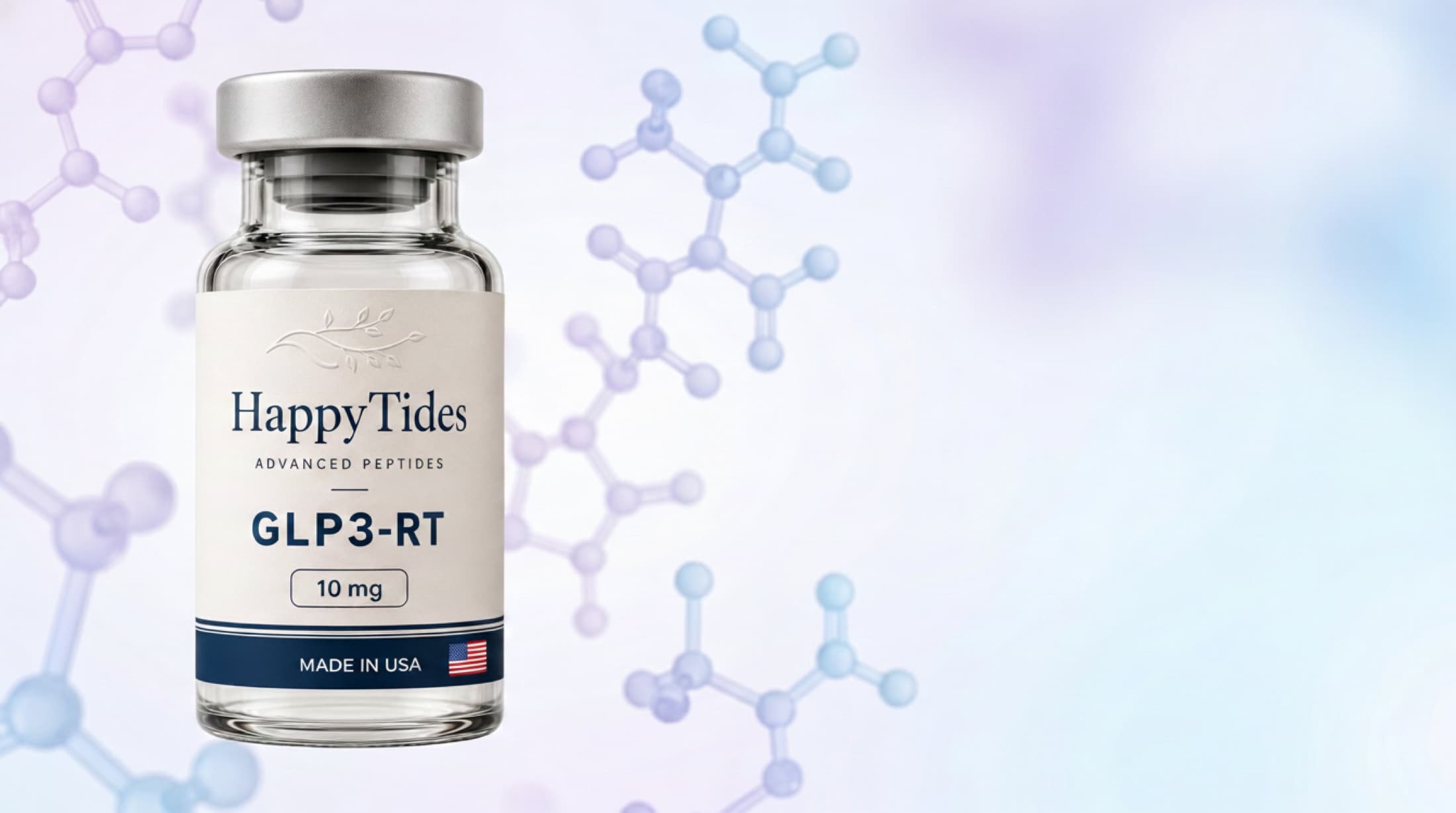
The overview
What is Semaglutide?
In receptor-pharmacology models, semaglutide is a full agonist at the glucagon-like peptide-1 receptor (GLP-1R), a class B G-protein-coupled receptor. Binding is clasped between the receptor extracellular domain and transmembrane core; cryo-EM of the semaglutide-GLP-1R-Gs complex shows canonical Gs coupling with a sharp kink in transmembrane helix 6. Receptor activation engages stimulatory Galpha-s, activating adenylate cyclase and raising intracellular cyclic AMP, with reported recombinant GLP-1R binding affinity of ~0.38 nM. Downstream signaling involves PKA and Epac2 pathways, alongside beta-arrestin recruitment and Gq-dependent components described in GLP-1R-expressing cells. Structurally, an alpha-aminoisobutyric-acid (Aib) substitution at position 8 confers resistance to DPP-4 cleavage, the Lys34-to-Arg change directs site-specific acylation, and a C18 fatty-diacid side chain on Lys26 (via a gamma-Glu/OEG linker) drives reversible albumin binding that prolongs molecular residence in vitro. These features are characterized in biochemical, structural, and cell-signaling assays.
In the research
Where Semaglutide shows up
The areas researchers focus on with Semaglutide - and why it has the science community paying attention.
- GLP-1 receptor (class B GPCR) agonist binding and structural pharmacology
- Galpha-s / adenylate cyclase / cyclic-AMP signal transduction in receptor-expressing cells
- beta-arrestin recruitment and biased-agonism profiling at GLP-1R
- DPP-4 enzymatic stability conferred by Aib8 substitution (in-vitro peptidase assays)
- Albumin-binding fatty-acid acylation and molecular protraction mechanisms
- Cryo-EM structural dynamics of peptide-GLP-1R-Gs complexes
- Comparative GLP-1R agonist receptor-affinity and potency characterization
By the numbers
The facts that matter
To the molecule
Molecular specifications
H-His-Aib-Glu-Gly-Thr-Phe-Thr-Ser-Asp-Val-Ser-Ser-Tyr-Leu-Glu-Gly-Gln-Ala-Ala-Lys(modified)-Glu-Phe-Ile-Ala-Trp-Leu-Val-Arg-Gly-Arg-Gly-OH (31-residue GLP-1(7-37) backbone with Aib8 and Arg34 substitutions; Lys26 acylated with a C18 fatty-diacid via a gamma-Glu/2x-AEEA/OEG linker). One-letter backbone reference (pre-modification): H-Aib-EGTFTSDVSSYLEGQAAKEFIAWLVRGRGSourced, not claimed
The science behind it
The peer-reviewed studies behind Semaglutide, linked so you can read them yourself.
- Lau J, Bloch P, Schäffer L, Pettersson I, Spetzler J, Kofoed J, Madsen K, Knudsen LB, McGuire J, Steensgaard DB, Strauss HM, Gram DX, Knudsen SM, Nielsen FS, Thygesen P, Reedtz-Runge S, Kruse T (2015). Discovery of the Once-Weekly Glucagon-Like Peptide-1 (GLP-1) Analogue Semaglutide Journal of Medicinal Chemistry.
“The GLP-1R affinity of semaglutide (0.38 ± 0.06 nM) was three-fold decreased compared to liraglutide, whereas the albumin affinity was increased.”
- Knudsen LB, Lau J (2019). The Discovery and Development of Liraglutide and Semaglutide Frontiers in Endocrinology.
“Reversible binding to albumin was used for the systemic protraction of liraglutide and semaglutide, with optimal fatty acid and linker combinations identified.”
- Zhang X, Belousoff MJ, Liang YL, Danev R, Sexton PM, Wootten D (2021). Structure and dynamics of semaglutide- and taspoglutide-bound GLP-1R-Gs complexes Cell Reports.
“Semaglutide and taspoglutide display similar peptide interactions to GLP-1 but different motions within the receptor and bound peptides.”
- Zhang Y, Sun B, Feng D, Hu H, Chu M, Qu Q, Tarrasch JT, Li S, Sun Kobilka T, Kobilka BK, Skiniotis G (2017). Cryo-EM structure of the activated GLP-1 receptor in complex with a G protein Nature.
“The peptide is clasped between the N-terminal domain and the transmembrane core of the receptor, and further stabilized by extracellular loops. Conformational changes in the transmembrane domain result in a sharp kink in the middle of transmembrane helix 6, which pivots its intracellular half outward to accommodate the α5-helix of the Ras-like domain of Gs.”
Straight answers
Questions, answered
Is Semaglutide approved by the FDA?
No. Semaglutide is not an FDA-approved drug. We supply it as a research-use-only reference compound, identity-verified for purity with a COA on every vial.
What class of compound is Semaglutide?
Semaglutide is classified as: Acylated GLP-1 receptor agonist (incretin mimetic; long-acting glucagon-like peptide-1 analogue).
What is the molecular weight of Semaglutide?
The molecular weight of Semaglutide is 4113.58 g/mol (average; reported 4113.58-4113.64; ~4114 Da), with a molecular formula of C187H291N45O59.
What is the CAS number for Semaglutide?
The CAS Registry Number for Semaglutide is 910463-68-2.
What is the amino acid sequence of Semaglutide?
Semaglutide has the sequence: H-His-Aib-Glu-Gly-Thr-Phe-Thr-Ser-Asp-Val-Ser-Ser-Tyr-Leu-Glu-Gly-Gln-Ala-Ala-Lys(modified)-Glu-Phe-Ile-Ala-Trp-Leu-Val-Arg-Gly-Arg-Gly-OH (31-residue GLP-1(7-37) backbone with Aib8 and Arg34 substitutions; Lys26 acylated with a C18 fatty-diacid via a gamma-Glu/2x-AEEA/OEG linker). One-letter backbone reference (pre-modification): H-Aib-EGTFTSDVSSYLEGQAAKEFIAWLVRGRG.
Go deeper
More on Semaglutide
Keep exploring
Related peptides
For in-vitro laboratory research use only. Not for human or animal consumption. Bodily introduction into humans or animals is strictly prohibited by law. Semaglutide is not a drug and is not intended to diagnose, treat, cure, or prevent any disease. These statements have not been evaluated by the FDA.