
Learn · Topic guide
GLP-1 / Incretin Agonists Explained
The incretin system is one of the most studied signaling axes in modern receptor pharmacology, and the peptides that engage it have become reference tools for probing class B G-protein-coupled receptor (GPCR) biology in vitro. "Incretin" describes gut-derived peptides that amplify cellular signaling in response to nutrient cues, acting through a small family of related receptors. This reference article surveys the molecular logic of those receptors, GLP-1R, GIPR, and the glucagon receptor (GCGR), and explains how synthetic peptide agonists are classified by the number of receptors they engage: mono-agonists, dual agonists, and triple agonists. Where specific peptides are named, the discussion draws only on laboratory-characterized data: semaglutide as a GLP-1R mono-agonist and retatrutide as a unimolecular GIPR/GLP-1R/GCGR triple agonist. Throughout, the framing is strictly biochemical and structural, describing receptor binding, cyclic AMP (cAMP) accumulation in recombinant cells, and the engineering features that govern molecular stability in assay systems. No clinical, dosing, or therapeutic interpretation is offered or implied; the content is intended for laboratory-research and receptor-signaling education only.
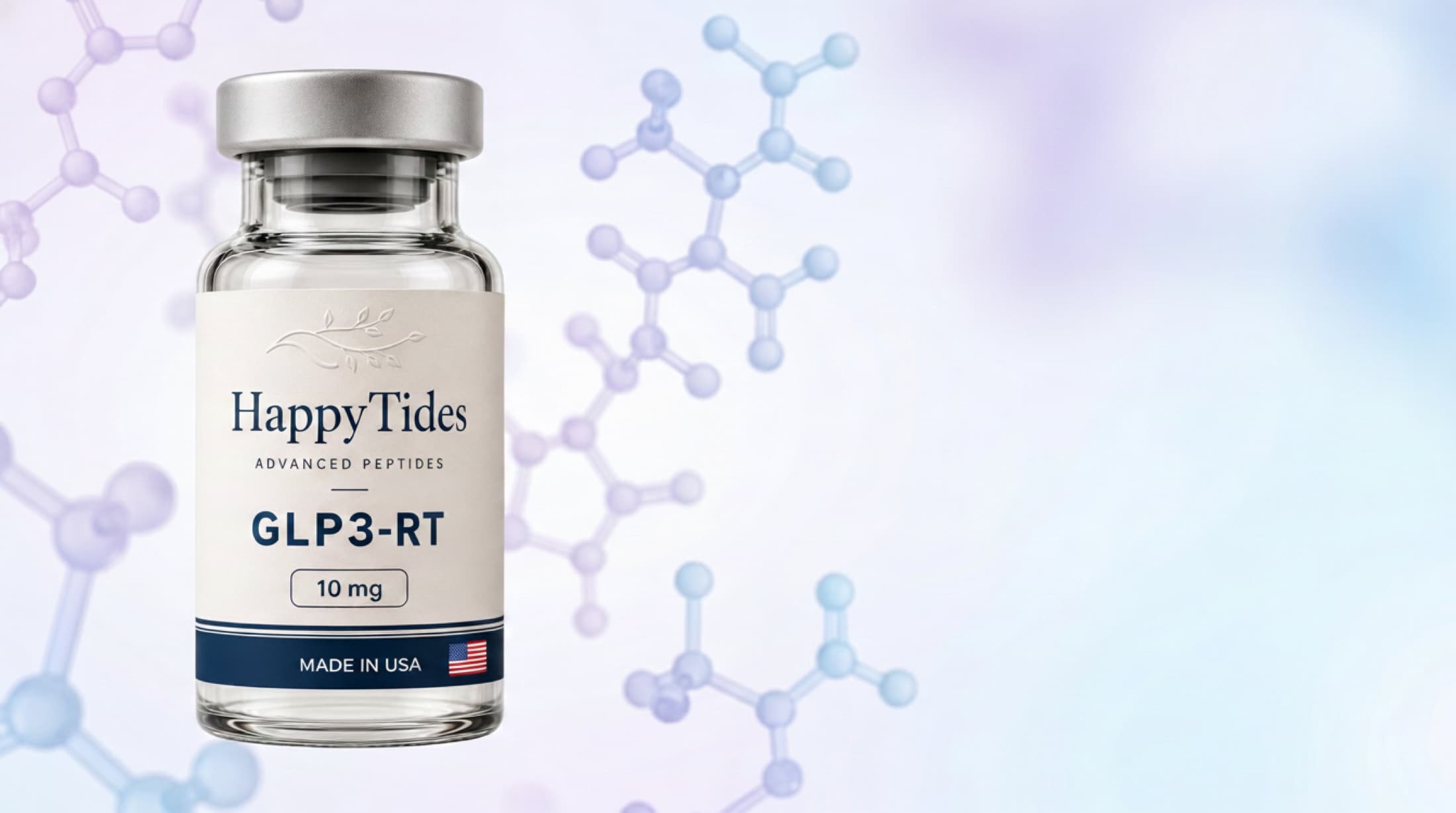
Section 01
What Incretin Biology Describes at the Receptor Level
In cell-signaling terms, the incretin axis is built on a set of structurally related class B (secretin-family) G-protein-coupled receptors.
In cell-signaling terms, the incretin axis is built on a set of structurally related class B (secretin-family) G-protein-coupled receptors. The two canonical incretin receptors are the glucagon-like peptide-1 receptor (GLP-1R) and the glucose-dependent insulinotropic polypeptide receptor (GIPR); the closely related glucagon receptor (GCGR) rounds out the family targeted by multi-agonist research peptides. As a general principle of class B GPCR pharmacology, each of these receptors couples to the stimulatory G-protein (Gs). Agonist binding therefore activates adenylyl cyclase, raises intracellular cyclic AMP (cAMP), and engages downstream protein kinase A (PKA) signaling. Because cAMP accumulation is the shared readout, it is the standard quantitative measure used to compare agonist potency and efficacy across all three receptors in recombinant cell systems. These receptors share a two-domain architecture: a large extracellular domain that captures the C-terminal portion of the peptide ligand, and a transmembrane core whose orthosteric pocket receives the peptide N-terminus to trigger the active-state conformation. This conserved "two-step" engagement is the structural foundation on which all incretin-class agonists, mono- or multi-receptor, are built and studied in vitro.
Section 02
Mono-Agonism: Semaglutide as a GLP-1R Reference Ligand
In recombinant-cell assays its reported GLP-1R binding affinity is approximately 0.
Semaglutide is characterized in the dataset as a full agonist at the GLP-1 receptor, a class B Gs-coupled GPCR, making it a single-receptor (mono-agonist) reference point. In recombinant-cell assays its reported GLP-1R binding affinity is approximately 0.38 nanomolar, and receptor activation engages Galpha-s, adenylyl cyclase, and cyclic-AMP production, with downstream PKA and Epac2 pathways plus beta-arrestin recruitment described in GLP-1R-expressing cells. Cryo-EM of the semaglutide-GLP-1R-Gs complex shows canonical Gs coupling with a sharp kink in transmembrane helix 6, a hallmark of the active-state conformation. Structurally, semaglutide is a 31-residue analogue of human GLP-1(7-37) with roughly 94% sequence homology to the native peptide. Three engineering features define its laboratory behavior: an alpha-aminoisobutyric-acid (Aib) substitution at position 8 confers resistance to DPP-4 cleavage; a Lys-to-Arg change at position 34 directs site-specific acylation; and a C18 fatty-diacid side chain on Lys26, attached through a gamma-Glu/OEG linker, drives reversible albumin binding that prolongs molecular residence in vitro. The molecular formula is C187H291N45O59 with an average mass near 4114 daltons (CAS 910463-68-2). These features are studied purely in biochemical, structural, and cell-signaling assays.
Section 03
Dual and Triple Agonism: Engineering Multi-Receptor Engagement
Multi-agonism is a peptide-engineering strategy in which a single molecule is designed to activate more than one incretin-family receptor.
Multi-agonism is a peptide-engineering strategy in which a single molecule is designed to activate more than one incretin-family receptor. Dual agonists engage two receptors (typical combinations pair GLP-1R with GIPR, or GLP-1R with GCGR), while triple agonists engage all three: GIPR, GLP-1R, and GCGR. Because each receptor reads out through Gs and cAMP, the defining laboratory question for any multi-agonist is its relative potency, or balance, across the receptor panel, measured as comparative cAMP signaling in recombinant cells. The structural challenge is that one peptide backbone must satisfy the orthosteric pockets of several related but distinct receptors at once. As a general design principle in this class, the conserved N-terminal region drives the shared active-state trigger, while sequence variation in the peptide's mid-region is read out by receptor-specific extracellular-loop and transmembrane-tip contacts. Non-coded residues such as Aib and alpha-methyl-leucine are introduced to confer protease resistance and stabilize the peptide helix, and fatty-diacid acylation is used to promote albumin binding for extended residence in assay systems. These are mechanistic, model-system characterizations of receptor engagement, not statements about physiological outcomes.
Section 04
Retatrutide: A Unimolecular Triple Agonist in Structural Detail
In cell-based cAMP assays the molecule shows relatively greater GIPR activity with comparatively balanced GLP-1R and GCGR engagement.
Retatrutide is described in the dataset as a synthetic, unimolecular triple agonist that engages the GIP receptor (GIPR), GLP-1 receptor (GLP-1R), and glucagon receptor (GCGR), all class B1 Gs-coupled GPCRs. In recombinant cell systems each receptor couples to Gs, so agonist binding drives adenylyl-cyclase activation and intracellular cAMP accumulation, the standard potency readout. In cell-based cAMP assays the molecule shows relatively greater GIPR activity with comparatively balanced GLP-1R and GCGR engagement. It is a 39-residue peptide built on a GIP-based backbone. Cryo-electron microscopy of the peptide bound to each receptor-Gs complex shows a conserved N-terminal interaction inserting into the orthosteric transmembrane pocket to trigger the active state, while mid-region sequence variation is read out by receptor-specific extracellular-loop (ECL1/ECL2) and TM1-tip contacts, rationalizing simultaneous tri-receptor activation. Key modifications include Aib at positions 2 and 20, alpha-methyl-L-leucine at position 13, a C-terminal amide, and C20 fatty-diacid acylation via a gamma-Glu/AEEA linker on Lys17; the non-coded residues confer protease resistance and helix stabilization while the lipidation promotes albumin binding. Its molecular formula is C221H342N46O68, average mass 4731.33 g/mol (CAS 2381089-83-2).
Section 05
Comparing the Two Reference Peptides Side by Side
Placing the dataset's GLP-1R mono-agonist beside its triple agonist illustrates how receptor scope shapes molecular design.
Placing the dataset's GLP-1R mono-agonist beside its triple agonist illustrates how receptor scope shapes molecular design. Semaglutide targets a single receptor, GLP-1R, with a reported affinity near 0.38 nM and a 31-residue GLP-1(7-37)-derived backbone; retatrutide targets three receptors from a 39-residue GIP-derived backbone, with comparatively greater GIPR activity. Despite different receptor counts, both rely on a shared toolkit visible in the data. Each uses an Aib substitution to blunt DPP-4 proteolysis, a known liability of native incretin peptides. Each carries a fatty-diacid acylation, C18 on semaglutide's Lys26, C20 on retatrutide's Lys17, attached through gamma-Glu/AEEA-type linkers to drive reversible albumin binding and extend in-vitro residence. And both have had their active-state engagement resolved by cryo-EM in complex with the receptor-Gs assembly, confirming the conserved N-terminal-into-orthosteric-pocket mechanism. The principal divergence is selectivity: the mono-agonist's signaling is confined to one cAMP-coupled receptor, whereas the triple agonist's defining laboratory property is its balance of cAMP output across GIPR, GLP-1R, and GCGR. These comparisons are strictly biochemical and structural.
Section 06
How These Receptor-Signaling Properties Are Measured in Vitro
Binding affinity, such as semaglutide's reported ~0.
Across the incretin class, a small set of laboratory methods recurs, and understanding them clarifies what every potency or affinity number actually represents. Binding affinity, such as semaglutide's reported ~0.38 nM at GLP-1R, is typically determined in receptor-binding assays against recombinant receptor preparations. Functional activation is quantified by cAMP-accumulation assays in cells expressing the cloned receptor; because GLP-1R, GIPR, and GCGR are all Gs-coupled, cAMP is the common currency for comparing potency and for defining whether a multi-agonist is balanced or skewed toward one receptor. Beyond Gs/cAMP, secondary readouts noted for GLP-1R include beta-arrestin recruitment and PKA/Epac2 pathway engagement, used to profile signaling bias. Structural mechanism is resolved by cryo-electron microscopy of the peptide-receptor-Gs ternary complex, which visualizes the active-state conformation, including features like the transmembrane-helix-6 kink seen with semaglutide. Enzymatic-stability assays measure resistance to DPP-4 cleavage conferred by Aib substitutions, and biophysical studies characterize albumin binding from fatty-diacid acylation. Every claim in this article rests on these in-vitro, structural, and biochemical assay types; none should be read as a physiological, clinical, or outcome-based statement.
Straight answers
Frequently asked questions
What does "incretin" mean in receptor-signaling terms?
In a laboratory context, the term refers to a family of gut-derived peptides that signal through related class B G-protein-coupled receptors, principally GLP-1R and GIPR, with the closely related glucagon receptor (GCGR) also targeted by research peptides. All couple to the stimulatory G-protein Gs and raise intracellular cyclic AMP, which is the standard assay readout for measuring agonist activity.
What is the difference between a mono-, dual-, and triple agonist?
The distinction is how many incretin-family receptors a single peptide molecule activates. A mono-agonist engages one receptor, a dual agonist engages two, and a triple agonist engages all three (GIPR, GLP-1R, GCGR). Because each receptor signals through Gs and cAMP, multi-agonists are characterized in vitro by their relative, or balanced, cAMP potency across the receptor panel.
Which receptor does semaglutide act on, and how potent is it in the data?
Semaglutide is characterized as a full agonist at the GLP-1 receptor (GLP-1R), a single class B Gs-coupled GPCR. The dataset reports a recombinant GLP-1R binding affinity of approximately 0.38 nanomolar, with receptor activation engaging Galpha-s, adenylyl cyclase, and cyclic-AMP production in receptor-expressing cells.
Why is retatrutide called a "unimolecular triple agonist"?
Because it is a single 39-residue peptide molecule engineered to activate three receptors at once, GIPR, GLP-1R, and GCGR, rather than a mixture of separate molecules. Cryo-EM shows a conserved N-terminal interaction triggering the active state across all three receptor-Gs complexes, while mid-region sequence variation is read out by receptor-specific extracellular-loop and transmembrane-tip contacts.
What structural modifications make these peptides stable in laboratory assays?
Both reference peptides use alpha-aminoisobutyric-acid (Aib) substitutions to confer resistance to DPP-4 cleavage, a known liability of native incretin peptides, and fatty-diacid acylation (C18 on semaglutide's Lys26, C20 on retatrutide's Lys17) attached via gamma-Glu/AEEA-type linkers to promote reversible albumin binding and extend molecular residence in vitro. Retatrutide additionally carries alpha-methyl-leucine for helix stabilization.
How are these receptor properties actually measured?
Through standard in-vitro methods: receptor-binding assays for affinity, cAMP-accumulation assays in cells expressing the cloned receptor for functional potency, beta-arrestin and PKA/Epac2 readouts for signaling profiling, cryo-electron microscopy of the peptide-receptor-Gs complex for active-state structure, and enzymatic-stability assays for DPP-4 resistance. Every figure in this article comes from these assay types.
Does this article describe any clinical or therapeutic use?
No. The content is strictly limited to in-vitro receptor pharmacology, structural biology, and cell-signaling characterization. It describes how these peptides bind and activate receptors in laboratory systems and does not make, imply, or support any clinical, therapeutic, dosing, or outcome-related claim.
Keep exploring
Continue learning
For in-vitro laboratory research use only. Not for human or animal consumption. Educational content, not medical advice; not intended to diagnose, treat, cure, or prevent any disease. Not evaluated by the FDA.